Uni5 Self Awareness
- Details
- Parent Category: Vedic Literature
- Category: Silapathikaram - Kannagi
- Hits: 14819
THE SACRED STONE FOR EXORCIST RITUAL
Kerala state is very famous for its Devi goddess] temples. There are 108 Devi temples considered to be very important. Our ancestors have studied each and every aspect of human life in detail.
Our ancestors have concentrated much in human psychology. Modern medicine has started accepting the fact of '' mind and health''. But in ancient India , the Aayur vedic and Siddha medicinal systems have focused mainly on mental health parallely to physical health.
All great civilizations believe in black magic, spirits and evil energy as devils, ghosts and demy gods. People believe that human beings are often affected by these negative forces and the life becomes sorrowful.
But Indians has made the real spiritualism as the treatment for such patients. We will never feel bad our life and tough timings , if we visit a place called Chotranikara near Ernakulam city.
It is a very famous Devi shrine in our nation . It is the place were the mentally disturbed patients are treated without any medication. The rituals and chants alone will cure them. If we see the patients and their family suffering , we will thank God for making us to live as such. One will give up the desire for wealth and fame if he or she observe the mental illness of such patients.
Chotranikara Bahavathy:
Chotranikara is actually named as '' Jothy yalundha kara''. It means the river bank where goddess appeared as a flame. It is near Ernakulam city. It is very small town with many cottages and hotels. The shrine is very famous for the exorcism and ancestral rituals.
The temple has very strong link with Kannagi. Let us enter into the temple. The main shrine is located on a raised altar. We need to be there at 4 A.M to see an auspicious deity.
By 4 A.M when the conch blew , the doors are opened. Inside the small sanctum we can see a 5 feet height rock and a small rock also near by. The rocks are dark in color. They are considered as Goddess and Krishna . The goddess is form less and priests clean the sandal paste and flowers from the idols [ rocks].
Then they start washing the idols with cold water . There is a small golden disc as thaale fixed to the idol. Then the idol is decorated and rituals will be done. This idol is Devi Bahavathy. She is decorated as Saraswathy [ goddess of wisdom] in morning with pur white garments and jewels.
By 11 A.M the golden mask of the goddess will be fixed to the rock and decorated as Mahalaxmi [ goddess of wealth] Green , yellow garments will be used to depict wealth.
The golden mask :
The golden mask of the goddess is very big. She showers the true motherly love and affection from her eyes which cures all the mental and physical disturbances. She has 4 hands. She bears a conch and disc . 2 other hands show the symbol of give abode and blessing. The mask will be decorated with unique jewels like in Kodungalloor . Plenty of flowers , lemons adorn her mask. The shrine is illuminated with many ghee lamps.
By evening, the goddess will decorated as Durga [ goddess of power] with red cloths. By 7 P.M she will be decorated as Kaali [ the ultimate source of universal energy] with blue cloths.
Then the tiny golden idol of goddess will be taken around the shrine on an elephant for 3 times. I am explaining other rituals and legends about this temple now.
I was made to focus on the tiny golden idol. The goddess has 2 hands holding an anklet and sword. Haa !!! she is Kannagi! My mind just woke up and started searching for her foot prints . How Kannagi came to this place? I was waiting to go home soon to refer the literature.
Who saved the sacred rock?
Silappathykaaram says that there was a sacred dark stone in the central part of Poompuhar city. People who were disturbed by black magic, disease and evil energy were made to stay near this stone for few days. They believed that the stone will cure their mental and physical hazards. People lived in that city has respected the stone and worshipped.
This little piece of information made me to think a lot. What has happened to this stone. When the city got washed away by the early tsunami waves, many important historical objects must have been saved. When Kannagi's jewels and other things were saved; the Chera king must have saved this stone and the huge Shetrabalaka idol from Poompuhar city and installed here.
The goddess is decorated as Durga, Laxmi and Saraswathy. This temple is very famous for this type of decoration. Why they need to do the rituals like this? Again we need to see Silappathykaaram text.
Elango adikal praises Kannagi as the incarnation of all the three goddesses who killed Pandiya king and burnt Madurai. So our ancient Tamils respected women as the incarnation of goddess. This cult must have introduced the ritual methods in Chotranikara.
I have heared from few priests that even Kodungalloor amma has been worshipped as the 3 forms of goddesses in olden days. So Chotranikara temple is an another place linked with Kannagi cult. Let us travel towards Thiruvanandhapuram city - the state capital.
Dr.Madeswaran
- Details
- Parent Category: Vedic Literature
- Category: Other Vedic Literature
- Hits: 11234
KABILA ACHARYA AVATHARAM FROM SRIMATH NARAYANEEYAM
Maharshih KapilAcharyah Kritajno Medineepatih |
Tripadas Tredas-adhyaksho Maha-Shringah Kritaantakrit
||Vishnu Sahasranamam-SLOKA-57||
Maharshi Kapilaachaaryah with gratitude (Kritajno), the one who has mastered the entire knowledge (Medineepatih), the one who is the knower of all the created objects, guide us to cross the three realms (Body Mind and Intelligence) (Tripadas)to blissfully (Treedas) preside (witness/experience) (Adhyaksho) the highest state (Maha-Shringah) where one annihilates all actions (Sakthi-Awareness-Energy) to the Eternal actionless state (Consciousness-Para Brahmam) Kritaantakrit.
* Bhrama's son Swaayambhuva Manu meditated upon Lord Vishnu and listened to Vishnu Puranam and lived a contented life.
* By this time Bhrama's shadow created a son called Karthamar who is Prajapathy.
* Karthamar was very much interested in knowing the universal pattern and he meditated upon Lord Vishnu to attain the knowledge of universal pattern for 10,000 years and had the vision of Vishnu.
* Vishnu appeared before Karthamar and showed his lotus by which he was made to imbibe the wisdom of patterns.
* He also asked him to marry Manu's daughter Devahuthi.
* He said that they will give birth to 9 daughters and a son who will be Vishnu himself.
* Manu and his wife Sadharoopa were advised by Naradha to give their daughter Devahuthi to Karthamar.
* After wedding Karthamar was totally involved in Vishnu pooja and Devahuthi served her husband with real dedication and love.
* Karthamar was impressed by his wife's service and by his yogic trans he made her to enjoy the joy of youngness in all 5 levels and made her to be very happy. He mated her with 9 patterns of mind and gave birth to 9 daughters.
* So Karthamar was known as ''Navathma''.
* By serving her husband with true dedication Devahuthi was bestowed with all siddies.
* Karthamar wished to get into jungles for Sanyasa ashram and before that he blessed Devahuthi with a son who is the incarnation of Vishnu.
* The objective of Lord's incarnation as Kabila is to make the people to realize the ultimate truth about the ''self''.
Narayaneeyam explains further about Kabila's teachings to his mother Devahuthi as follows:
* The human mind is bonded to the 3 characters - Thamasic-Rajas and Sathwik.
* Because of these characters of mind the mind is bonded to all types of relations and attachments.
* When the mind is released from these bonds by the awareness, the amritha of moksha - ever bliss can be enjoyed by us.
* For that the mind has to be trained through ''bakthy marga''.[True surrender by total acceptance and service to all] True devotion and service to God releases our mind from all such bondages.
* So all wise men follow this batkhy marga and attains moksha. For attaining moksha bakthy marga alone is the easiest way.
* Moola prakruthy, mahath thathvam, ahankaram, 5 dhanmatras, panchaboothas, mind, 10 indriyas all these 24 thathvas joins with the 25th thathva called ''purusha''. When these 25 thathvas got realized by our mind the jeeva gets total liberation from all bonds and enjoys the bliss of anandha. [Splitting and simplifying the 25 thathvas is known as Sangiya School established by Kabila Deva]
* Prakruthi's characters never affects the purusha as long as the purusha makes himself relates to them with desires.
* But people who suffer from all these when worship me and trains themself with the spiritual lessons I give them the liberation from 24 thathvas.
* When a person with true love and pure thoughts worship me through pranayama, prathyaharanam, dhyanam and dhaaranai his mind will be released from the bonds.
* He is advised to worship and meditate my form residing upon Garuda.[Garuda is the symbol of Vedas - spiritual sciences]
* I appear upon Garuda with bluish complexion and I am decked with glittering gems and jewels. This form has to be meditated very often in the mind to get rid of ego.[very often spiritual practice has been said like this]
* Listen to my leelas, sing about me, feel me in everything which alone can be the weapon to chop the bonds. Such devotee will enjoy the bliss of liberation like the flow of Ganga.
* ''Son! What makes us to get into the hell of life?''
Kabila says, ''Mother! People, who just earn money and save them, people who just enjoy only the personal life, sex, children’s love with attachment, attachment to the family...ha! I feel very sacred to say how those people will suffer the hell upon Earth''
* During gestation the jeeva has wisdom, but when gets delivered he becomes ignorant and enjoys the attachment. He just spends his youth and become old and dies. He just wastes his life!
* Devahuthi aks, ''Son! Then what can Grahasthas can do?''
* Kabila answers, ''Mother! when a grahastha lives with real devotion and worships his Pithrus and Devathas, after his death, he just spends a good time in Dakshina marga, but when his account of good deeds gets over again he has to get into a birth cycle.''
* Devahuthi asks further, ''Ho..no! Then when can we do?''
* Kabila says, ''Mother! When a person really surrenders to me by ''nishkaama karma, he reaches the Uthara marga and enjoys the liberation, which means they merge with me which is called ''sathyo mukthy''
* ''People who are ignorant again and again takes birth through asura yoni'' [lower body level]
* By listening to this Devahuthi attained moksha and that place is northeast India is called as Gangasagaram.
* Kabila also went to that place and established his ashram and served the man kind.
* ''get surrender to the lotus feet of Lord, which alone can remove you from all fears and bless you with all needs'' says Kabila to his students.
The above article is based on Narayaneeyam. Dasakas: 14 and 15.
Bhagavatham
8: The Sons of Sagara Meet Lord Kapiladeva
http://srimadbhagavatam.org/canto9/chapter8.html
Canto 3b
https://issuu.com/aadhar/docs/canto3b-eng?e=1519898/32135455
Chapter 22: The Marriage of Kardama Muni and Devahûti
http://srimadbhagavatam.org/canto3/chapter22.html
Chapter 26: Fundamental Principles of Material Nature
http://srimadbhagavatam.org/canto3/chapter26.html
- Details
- Parent Category: Vedic Literature
- Category: Ramayan Uni5
- Hits: 24980
Sundarakandam
Sundarakandam is the most illustrious portion of Ramayan. Usually everyone translates Sundarkhand as most beautiful. Sundara also means most illustrious that means notably or brilliantly outstanding because of dignity or achievements or actions. Sundarkhand is about the acheivements of Hanuman.
Reciting sundarkand every night (atleast one success aspect of Hanuman) will bring a tremendous change in our life and attitude on life. One's mind will progress in an astonishing manner when one understand the Selfless nature of Hanuman.
"Man" in Sanskrit means the mind and "Hanu" means the pointed part of a spear head. "Hanuman" is that mind with one pointedness to Serve only God (Raam), the highest in Spiritual Sadhana. Only through Seva, one gets transformed to the divine (Moksha).
Hanuman is the Seva aspect of Lord Shiva, the Self-Awareness.
Selfless actions and attitude purifies all karmic negativities when done without any expectations. Only pure Love (unconditional) or doing for Selftual Joy (devotion) can make an action Selfless. With Selfless attitude (Hanuman's nature of action) releives one from the malefic effects of Saturn and Gulikan.
The key points in Sunderkhand and symbolism connecting our Self are given in bracketed bold letters.
If you have doubts please post your questions in this discussion thread.
click here for sundarakandam and wife husband harmony
{easyfolderlistingpro folder='images/uni5/pdf/English-PDF/Awareness-Spiritual/Uni5-CCC-CAC/Mind-Slokas-Music/Slokas/Vishnu-shlokas'}
Hanuman sloka
Anjanaa Garbha Sambootham Kumaaram Brahmachaarin'am
Dhushtagraha Vinaasaaya Hanumanthaaya Upaasmaye
Sarva Kalyana Dadaram
Sarva Aapathgana vaarakam ||
Apaara Karuna Moorthim
Aanjaneyam namamyaham ||
Srir Rama Dhoodha Maha Dheera
Rudra veerya Samadhbhava
Anjana Garbha Sambhoodha
Vayoo putra namasthuthe
Asaadya sathaka swamin
asaadyam thava kim vadha ||
Sri Ramadootha krupa sindho
Math kaaryam sadhaya prabho ||
- Details
- Parent Category: Vedas Sakthi
- Category: Vedic Arts
- Hits: 8480
Kalam and Kolams
- Details
- Parent Category: Vedas Sakthi
- Category: Vedic Arts
- Hits: 9338
Carnatic Music , folk songs and Hindustani Music
Every aspect in Vedic tradition has only one goal, to help one transcend to the Awareness state. Vedic Music is not an exception from that purpose. The repetition in carnatic (karnatic) and Hindustani music and in all Vedic dances are all meant for that pulling the mind inward to the deep Awareness state.
Repetition is seen in all Vedic arts and dances. The repetition might look boring but it has a tremendous impact on the spectators to help them transcend to the Awareness state. But 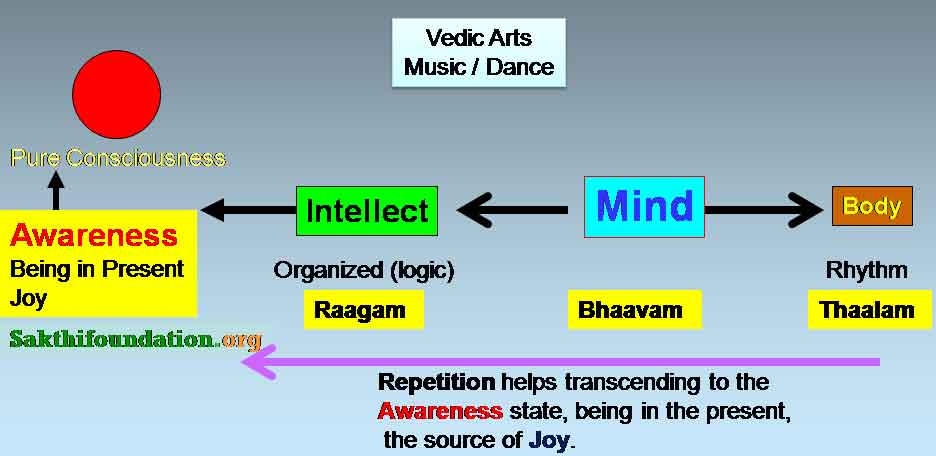 every time the artist repeats the sequence, he or she along with the audience transcend to the state of being, the Awareness state.
Hence all Vedic Arts whether it is Music or Dance were considered divine. Why divine, because they all help to transcend to the Awareness state, which is the state of "Being / Atman.
This aspect makes Carnatic and Hindustani and other folk songs of Vedic tradition distinct all from modern music. Modern music satiates the sensory mind and so gives instant pleasure in hearing it. It makes the body rock and tickles the sensory mind, but not help to transcend to the Awareness state. It keeps the mind more in the physical body and emotional-mind state.
Music in Vedic tradition are not only entertaining but also helps to transcend to the higher Self. All Vedic music gives spiritual "Aananda" verses the "happiness" given through other music (Click here to know the difference between Aananda & happiness).
The attitude of the performer is very different in the Vedic culture. The use their body mere as a tool to reach the state of Awareness that is what one reaches in Meditation. In this state one experiences bliss which is different from happiness. This is because one experience freedom from the wandering mind which is always anxious of the future or depressed about the past.
While performing or observing the Vedic Music or Dance, one transcends the wandering nature of mind, the Ego which overshadows always the Awareness state. The Awareness that we are not always aware of is brought about through Vedic Arts. This is the very purpose of Vedic Arts. It is like all other Vedic Rituals. Hence during this Vedic performance the skilled performer brings the Audience to this Awareness state. Hence all Music performers call their performance as "Sadhana".
Sadhana is a term used by a spiritual aspirant to reach the Awareness state. Music becomes a Sadhana because it helps to reach this Awareness state. great Musicians like Shri Thiayagarajar , Purandara Dasar reached the Divine state of Awareness through Music. Among the five Pancha bhootas, the Space element is the sound aspect that is closest to the Consciousness state.
The seven sounds are known in Indian notation as sadjamam, rsabham, gandharam, madhayamam, panchamam, dhaivatam, and nisadam. Namely, sa, ri, ga, ma, pa, dha, and ni. The specific origins came from specific sounds in nature.
The sounds are four
Vaikhari, the physical.
Will soon will come with the symbolism behind these notes.
| For more details |
Subcategories
SAL Energy
Rituals and SAL Energy
Rituals in Sanathana Dharma
Festivals in Sanathana Dharma
Rituals in other Traditions
Festivals in other Traditions
CAC
CCC/CAC/Literature
Vedic Literature - English
We have organized this section in the Uni5 pattern
Body-Rituals and Festivals- About symbolism of rituals, festivals
Mind- Slokas-Music-About slokas, sthothras and music ragas
Intelligence-Gods-Scriptures-about the literature of gods.
Awareness-Temples / Pilgrimage- About temples, pilgrimages
Consciousness-Devotees-About the life history of all different devotees, including patriots
Vedic Literature - Tamil
We have organized this section in the Uni5 pattern
Body-Rituals and Festivals- About symbolism of rituals, festivals
Mind- Slokas-Music-About slokas, sthothras and music ragas
Intelligence-Gods-Scriptures-about the literature of gods.
Awareness-Temples / Pilgrimage- About temples, pilgrimages
Consciousness-Devotees-About the life history of all different devotees, including patriots
Vedas Sakthi
Festivals
Pilgrimages
Yathra
Yatra