Uni5 Self Awareness
- Details
- Parent Category: Vedas Sakthi
- Category: Vedic Gods
- Hits: 15679
Indra
Indra is the King of the gods or Devas and Lord of Heaven or Svargaloka in Indian mythology. He symbolically represents Indriyas (Senses). In us, our five Senses rules everything. That senses gives us heavenly pleasures. Infact we attain maximum pleasure through the five senses. This is why indra is the Lord of Heaven (pleasures). His weapon is Vajra (thunderbold), which represent lightening speed of our senses.
In Puranic mythology, Indra is bestowed with a heroic and almost brash and amorous character at times, even as his reputation and role diminished in later parts with the rise of the Trimurti. This is because , the senses operate at the level of the body and mind, whereas intellect and Awareness is much higher than that. The Trimurthy's Bishnu and Shiva represent the intellect and Awareness.
Reference : More information on Indra to read.
- Details
- Parent Category: Vedas Sakthi
- Category: Vedic Gods
- Hits: 31979
Saraswathi
Saraswathi is depicted as the embodiment of Knowledge. Knowledge is obtained in three ways.
1. Through listening: We hear and learn. Right from childhood from parents and 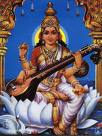 teachers we learn through listening. This continues even in professional training also. We also like to get the training in a meldoy form. This is why Saraswathi holds the veena instrument which gives melodious sounds for listening. The greatest wealth according to Thruvalluvar is the is the wealth of listening.
Hearing is different from listening. Hearing is a sesnual activity. When we connect our mind to the information we hear, then it becomes listening. We may interpret anything we hear according to our personality, which may be true or not true (yad bhaavam tad bhavati (you perceive according to your mental framework). Our views are biased because they are based on our likes and dilikes, like the blind men. Only a reference standard (wholistic view like Shasthras) can tell us whether our understanding synchronizes with the Universal Truth.
2. Reference: We always need reference books for two reasons. Reference material is to confirm our understanding and also for advancing more knowledge. This is why Saraswathi holds the Veda Shashtras (Science) in her hands. The Veda Shasthras is a reference of Unviersal Truth, which means true to all being at all times.
3. Practical Repeating and Contemplation: The knowledge has to be experienced which can happen only when it sink deep in our mind. So we need repetition. or practice (Abhyasa). As children, we imbibed many things by constantly repeating what we learnred. This is the reason why Saraswathy constantly rotates Roseary beads (Rudhraksha) in her hand to symbolize practical repetition and contemplatation.
White Sari: The three modes of getting knowledge depicted as Saraswathi image then symbolize the white color Sari she wears. When knowledge becomes Universally applicable it is pure which is depicted in white color. Unadultered, unquestionable is Pure.
Left foot down and Right foot folded: We have earlier discussed that right part of the body stimulates the left part of the brain which is the region of intelligence. The left part of the body stimulates the right part of the brain centers involved in emotions.
Hands represents doing action, in other words, knietic Energy in action. Legs represents moving or transforming Energy. Saraswathi draws her right leg inwards to represent inner transformation using knowledge. When there is inner transformation, our emotional mind is very relaxed. This is why Saraswathi's left leg is at ease.
Swan or Hamsa is a bird with the unique quality of drinking only milk leaving out water. Similarly our mind should always drink happiness leaving out adultering unwanted watery thoughts surrounding us.
Purpose of life is to be happy and ultimately Ananda.
- Details
- Parent Category: Vedas Sakthi
- Category: Vedic Gods
- Hits: 15285
Ganesha-3
Legends Connected With Lord Ganesha
How Ganesha Wins the Mango
Once the great sage Narada approached Lord Shiva and Parvathi to hand over them a rare Mango fruit of Knowledge. Since the fruit cannot be parted and given as a whole, he decided to give the fruit to the one who deserved it. So Shiva asked his sons Kartikeya and Ganesha to circle the world and return in a sort of a competition to see who would finish first. Kartikeya quickly took off on his peacock, but Ganesha walked around Shiva and Parvati. He explained that to him, his parents were the world and so circumbulating them would obviously mean circling around the world . Pleased with the thought, Shiva granted the fruit to Ganesha. Kartikeya alias Muruga got angry left everything and stood in Palani hills to get the diving knowledge.
Symbolism behind the story
Knowledge of the Self, is whole and cannot be parted. It is got through inquiry and Sage Narada (read the link) represents the inquiring mind.Shiva and Parvathi (Energy and Awareness) is the mother and Father of all creation. Muruga is like the Modern scientific approach of unraveling the mystery by researching the physical world. Ganesha is smart and does correct approach of transcending to the Awareness state (going around Shiva and Parvathi).
Kubera and Ganesha story:
Kubera, the god of wealth was very proud of his fortune. One day he organized a huge dinner in which Shiva and Parvati along with their son Ganesha were also present.
Ganesha started eating and became greedy for more. He emptied the dishes and plates of other guests also. Still not satisfied he started eating the plates, furniture and all the contents of Alakapuri, the main city of Kubera.
Frightened the god of wealth rushed towards Shiva’s feet to take his help. The remedy was very simple: Shiva gave his son a handful of roasted cereal grains. Ganesh ate it and his hunger stopped immediately.
Symbolism behind the story
Fire represents knowledge. Only when we have all the desires filtered through the fire of knowledge, can we satiate our hunger towards wealth. Wealth is needed for life, not wealth alone does not fulfill life. We should understand the importance of wealth through the spiritual knowledge, then we know how to use it for fulfillment of life and happiness.
- Details
- Parent Category: Vedas Sakthi
- Category: Vedic Gods
- Hits: 15596
Ganesha-2
The Lord of Beginnings
Why is Ganesha Worshipped first?
One would normally be inclined to ask:"Why is Ganesha first?" That is, to say, how come most every tradition of Hinduism puts Ganesha as the "Lord of Beginnings" and invokes or worships Him first instead of any other deity in the Hindu pantheon?
We can easily understand this fact because Ganesha represents the state of realizing the Awareness (Read Ganesha's story in the previous page). When Ganesha was created he was 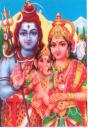 created a boy just enjoying "Modhaka", a sweet dish. He was not aware of his dad Shiva, the symbolic of Awareness. Most Human beings are in this state of enjoying the world without being aware of Awareness. Only being aware of Awareness, one becomes like Ganesha, realizing one's true potential.
Any task if we do without having awareness, can we be successful. Most of the times we end up in failures because of lack of awareness. So awareness is important while beginning any task. This is why Ganesha is worshipped first before doing any task because he represents the state of Awareness. All his features add's up to that state.
His big ears represents that we should be fully attentive in hearing sense. His trunk is the most versatile tool. The elephant trunk can pick up heavy logs and well as even a tiny needle. Being aware at any act we do, we accom;ish the best.
While we do any work, our mind is fully not in the present. While driving we think of what we are going to do in the office or thinking of incidents that happened in the past. At office while working the mind is not in the present, but thinking of again future plans or brooding over the past actions. Only place we are with full attention is in the movie hall. That is why as school children we had to read our books many times to remember them in exams, but we can recollect scene by scene of a movie we watch just one time.
So our ancestors have given the best way to do any task with full attention, like Ganesha who is fully Aware of Awareness, the Shiva. He is a creation of energy (Parvathi), but Aware of Awareness, Shiva. Before getting the elephant head, he was a boy who was an obstacle to shiva to meet Parvathi. In the form of Ganesha, with full awareness , all obstacles are removed. Through worshipping Ganesha, the one who removes obstacles, we are ought to be aware of our Awareness to accomplish our tasks without any obstacles .
Only with this transcending to this Awareness state we can realize the Cosmic Mystery. Modern Science tries to understand the Cosmic mystery through physical means of senses. Wheareas the ancient masters have done by transcending to the Awareness state. This is the symbolic message of the beautiful story of Mango and Ganesha.
- Details
- Parent Category: Vedas Sakthi
- Category: Vedic Gods
- Hits: 17971
Ganesha
Lord Ganesha is the elephant-headed God. He is worshipped first. His Names are repeated first 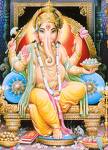 before any auspicious work is begun, before beginning any kind of worship. He is the eldest son of Lord Siva, and the elder brother of Skanda or Kartikeya. He rides on the Vahana, the small mouse. We will see why he has an elephant head and rides on a mouse and why he is worshipped before beginning any work.
Symbolism : Energy when it begins at the primordial level, will have highest density and will be formless. This primordial Energy (Mool Aadhara) nature is represented as Ganesha. This is the real reason to be worshipped. In other words he is the seed of Energy, but has all the potential to manifest the gigantic forms, he uis represented as elephant. Like at a gigantic banyan tree, it comes from a tiny seed. All the information of the gigantic tree is in the tiny seed, representing the symbolism of Ganesha.
The Elephant-Head
You are familiar with the story that Shiva cut the head of the boy born to Parvati , because the boy refused to let inside the house. If you take the story literally, then how can you worship a God like Shiva whose acts are even worse than a common man. Only if we understand the symbolism behind the story one can appreciate the great wisdom in these Puranic stories. Now let us see the story narrated about Lord Ganesha’s birth and his having the head of an elephant.
Once upon a time, at bathing time, the Goddess Gauri (Parvati), the spouse of Shiva, created Ganapati as a Suddha, or pure white being, out of the essence of her body, and placed Him at the entrance of the house. She told Him not to allow anybody inside and went for a bath. Lord Siva Himself returned home and was stopped by Ganesha at the gate. Siva got angry and cut off Ganesha’s head, taking Him for an outsider. Gauri came to know of this and grieved much. Vishnu went to bring the head of any creature that might be sleeping with its head northwards. The head of the Iravat (The elephant of Indira) was cut off and joined the head of the elephant to the body of Ganapati.
Lord Siva made Ganapati worthy of worship by men at the beginning of all their undertakings—marriages, journey, expedition, study, etc. He ordained that the annual worship of Ganesha, should take place on the fourth day of the bright half of Bhadrapada (August-September). ( Story adopted from Ganesh Chaturthi by Swami Sivananda).
Symbolism of Ganesha’s story:
Our body is the essence of the Universal Energy or Sakthi. This is symbolized by Gauri creating Ganesha from her own energy. The boy was ignorant of his dad Shiva and so did not allow him entry. We are like this boy not aware of the Awareness which is Shiva. Like Ganesha fighting with Shiva, we ignore our Awareness. This leads to suffering and our Ego head gets chopped off. But without Ego the energy in us cannot function. This is represented by Parvati geting angry. Then Vishnu, cosmic the intelligence, chops the head of Iravat , the 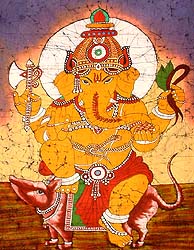 elephant of Indra. Indra represents Senses and cutting off Iravat's head represents the head who has control over the senses, indriyas or Indra.
But this overcoming Ego can only happen with the help of knowledge as symbolized by Vishnu.
Once we are aware of the awareness, then we function in this world without the head of Ego, but with Awareness, the perfect human being. This is what the elephant head of Ganesha represents. The elephant head represents a man fully aware of Awareness and without Ego.
Such a Self realized state is represented by ganesha, who then becomes the master (pati or Esha) of the thoughts (gana). Hence he is Ganapathi or Ganesha. Gana means form or thought. Pati or esha means leader or Lord. Ganapati or Ganesha means the lord /master/leader of forms/thoughts.
Why Ganesha rides on a mouse?: The huge body of Ganesha represents the great potential energy in us. This is why he is deity of Muladhara chakra. This big elephant headed energy but rides on a tiny mouse. Each and every cell of our body has tremendous energy, like an atom bomb harboring energy. Similarly the Enormous Ganesha like energy is present in us and lying dormant and we waste our life not knowing it.
"Tragedy of life is not death, but not knowing one's own potential while living is the greatest tragedy of life" - Mata Amritananda mayi Devi.
Ganesha riding on a tiny mouse shows reminds us that we are not a tiny creature, but the very manifestation of the divine and can realize this truth using this body, by being aware of Awareness (click here to know what Awareness is).
Subcategories
SAL Energy
Rituals and SAL Energy
Rituals in Sanathana Dharma
Festivals in Sanathana Dharma
Rituals in other Traditions
Festivals in other Traditions
CAC
CCC/CAC/Literature
Vedic Literature - English
We have organized this section in the Uni5 pattern
Body-Rituals and Festivals- About symbolism of rituals, festivals
Mind- Slokas-Music-About slokas, sthothras and music ragas
Intelligence-Gods-Scriptures-about the literature of gods.
Awareness-Temples / Pilgrimage- About temples, pilgrimages
Consciousness-Devotees-About the life history of all different devotees, including patriots
Vedic Literature - Tamil
We have organized this section in the Uni5 pattern
Body-Rituals and Festivals- About symbolism of rituals, festivals
Mind- Slokas-Music-About slokas, sthothras and music ragas
Intelligence-Gods-Scriptures-about the literature of gods.
Awareness-Temples / Pilgrimage- About temples, pilgrimages
Consciousness-Devotees-About the life history of all different devotees, including patriots
Vedas Sakthi
Festivals
Pilgrimages
Yathra
Yatra