Uni5 Self Awareness
- Details
- Parent Category: Vedas Sakthi
- Category: Rituals
- Hits: 12916
Camphor
Camphor is a very unique chemical that will vaporize directly from solid to gaseous state even without undergoing the intermediate state of liquid state. Camphor also has a unique smell or
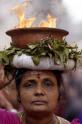 Vasana. Vasana in Sanskrit and Tamil languages also mean impressions of the mind. In the section Vasana we discussed that the impressions in the mind has to be cleared to attain free from the ever ending cycle of births and deaths.
This is symbolically done in all rituals as the burning of camphor is the fire of knowledge. The fire for extinguishing the vasana is the knowledge about the Self. Unlike burning other materials camphor does not leave any trace of it in the form of ashes. It completely vaporizes and so should be of mental impressions that should be extinguished even without expressing it (liquid form) and leave no trace of it, which means no identity about our Ego.
In almost all Vedic rituals this burning of the camphor is performed as a ritual in the culmination of events and the image of the God is shown when the camphor burns to symbolize that the Self is revealed in the light of extinguishing camphor. Without extinguishing even traces of mental impressions of desires there is always a return to the cycle of death and birth.
See additional discussion about camphor and rebirth.
- Details
- Parent Category: Vedas Sakthi
- Category: Rituals
- Hits: 9293
Incense Sticks
These following questions are discussed here
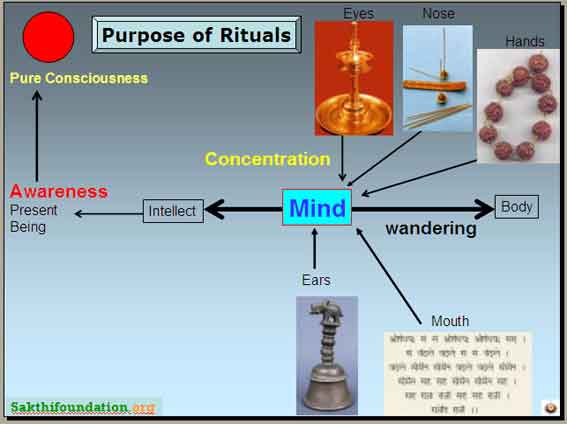
1. Why do we use lamp (light), incense sticks chanting, rotate rosary beads in rituals?
2. Whys is bell rung in aarathi or Arti?
3. Why do we close eyes in prayer?
As we discussed in the earlier sections that seclusion helps a child to focus in studying his school books by preventing distracting thoughts in the mind. A spiritual place of worship is also meant for the very same environment that would be less distracting for the mind, so that it will be available for transcending.
The rituals or mode of worship should lead the individual to the awareness state. The place or ritual should help in less distraction for the mind. By the way here we do not mean by physical silence. Contrary is true because sounds of bells , prayers, songs, chanting, instrumental music drum beatings etc lead the distracting mind to the state of awareness.
There are five sense organs (Eyes, nose, skin (hands), mouth and ears ) and the mind wanders when these five organs give stimuli to the mind. A temple or a puja room give these five sense organs stimuli that would allow the wandering mind to stay in focus. The bright lamp offers stimuli to the eyes, the smell of fragrant incense sticks to the nose, while the hands rotate rosary beads and mouth keeps chanting the prayers. In spite of these actions the mind wanders , but when the mind hears the most subtlest sense of sound through ringing of the bells, the wandering mind comes back to the present. This is called Arti or aarathi.
The mind will can stay focus only if there is some logic and so these logical work given to the five senses will help them to grab on it and so the mind is free to focus or transcend to the state of awareness. This transcendence is prayer. Prayer is transcending to our own Self which religion calls as God. There is no external God which can exclude this internal Self. Hence while praying we close our eyes to with draw our mind internally. This very act of closing eyes in prayer is a symbolic representation of with drawing mind to the Self.
- Details
- Parent Category: Rituals
- Category: Social Rituals
- Hits: 9896
Sacred Medicines
Sacred medicines indicate the holistic nature of the traditional ways of healing. Temples, customs and the rituals associated with them also have health implications. Some
of these are consciously devised. The temple culture always had a hidden agenda of health
associated with it. It was the Vedic schools associated with temples that promoted Ashta
Vaidya (Eight Medicinal) families. Apart from supernatural ways of healing and emotional services, in some temples certain medicines are also administered.
The medicine given as prasadam at Thiruvizha temple at Cherthala is believed to be an effective remedy against mental disorders, leprosy, dropsy (edema: swelling from excessive accumulation of serous fluid in tissue)etc.
Valiyenna is medicated oil prepared at Sastha temple at Thakazhi using 84 bazaar medicines and 64 green herbs. This oil is believed to be a panacea for all kinds of illnesses. Such rational treatments carried out in the spiritual background are present in Payyannur temple also.
Turmeric prasadam of the Cheemeni Mundya temple is believed to be a panacea by devotees. Turmeric is effective against a broad spectrum of microbes.
Thachumanthram is a curative ritual practiced in the domestic environment. It is practiced mainly to treat evil eye. Traditionally, magicians of Malaya community practice this. Main
ritual of the Thachumanthram consists of fanning the whole body with twigs of Nochi
(Vitex negundo).
Some of the non-conventional treatment concepts such as Teliotherapeutics
, Spiritual Healing, and Universal Life Energy are being hotly discussed now. Mikao Usuui
known as the father of Reiki, a non-conventional mode of treatment which has become
popular even in western countries, was inspired by certain Indian traditions and Buddhist
sutras. In this context ‘irrationality’ in our primitive systems of supernatural treatments
needs to be re-examined.
References - Materia Medica of the Local Health Traditions of Payyannur- Unnikrishnan. E (Kerala Research Programme on Local Level Development, Centre for Development Studies, Thiruvananthapuram - 2004)
- Details
- Parent Category: Rituals
- Category: Social Rituals
- Hits: 13457
Wedding Ritual
13.Vivāha -marriage. This Sanskar (Sanskaaram, Sanskaar) is the entry into the second Ashram (Stages) .
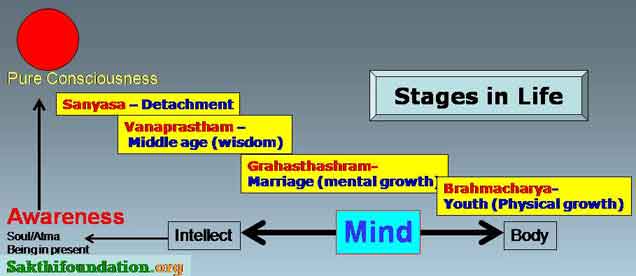
The first important day of our life is the birth day of our Body. In this first stage of life, the Brahmacharya, we matured the physical body. Next the second most important day is the wedding day, the second stage of life to mature our Mind, the Graha Ashram. We understand that the purpose of marriage is to mature the mind by expanding our heart space to another person and share the easy and hard lessons of life.
Many weddings are done in presence of a huge gathering with all rituals, while others are simple without any ritual involving only the couple. However not all weddings are successful either because the couple cannot cope up with each other or caused by the interference of the in-laws.
 Are these traditional wedding rituals a waste of time and money and meaningful for modern couples? Ancient wise people understood that the laws that govern the cosmos if reflected in our life will help us to solve problems that one will encounter in a married life. The Vedic system recognizes that in Cosmos, the Energy undergoes change within itself during the creation of the suns, planets and life on Earth. This aspect in seen in the Female body referring her to Sakthi. The Male is the unchanging phenomenon which initiate’s creation but remain the same in all creation.
Purpose of wedding:
Bharath's wedding is based on the Purusha (Consciousness) and Prakruthi (Energy) Principles of the Universe. The Energy goes (Transcends) towards the Consciousness. Hence in Bharath's wedding and all over the world, it is the bride that walks towards the groom.
The purpose of wedding is to attain Moksha, the Eternal bliis of unconditional existence. However, it also caters the temporary three levels of happiness of the sensorial body, emotional mind and organizational intelligence. Nevertheless, it is the Self Awareness that drives us towards Consciousness, therefore in all the wedding rituals, Awareness of the self is reflected.
It is a pity that current couples are not enlightened of the importance of these rituals and their connection to their married life and endup in unhappy married life and divorce. A married couple is enlightened to live like selfless organs in a healthy body and not like a selfish cancer of the body. It is Sacrifice (Thyaga), the only fuel that drives marriage to shoulder a great society. It is of no logic for a woman to ask why I should only sacrifice and not men, like heart asking why should I only work nonstop, while the legs rest in the night. This does not mean sacrifice is only for woman, but also for man.
A human body, family, society, country and Universe functions properly due to selfless team work. To highlight that concept, Bharath's wedding involves not a cancerous "living together of two individuals" but an active role of parents, family, relatives, friends along with the society in the life of a couple. This is why Bharath's wedding invites and gives active role for all the family members, relatives, friends and members of the social organization.
The invited do not merely come to show off their social status (rich jewels and clothing, imported cars) at the wedding, but feel and share their responsibility in creating a selfless couple, because tiny droplets make a mighty ocean. This means if a society creates more and more selfless couples who does their Dharmic roles (self responsibility), then all are benefited to live in a happy society.
The Dharma of a married couple is live with a cancer free mind of giving birth to healthy (body and mind) children and raise them for the betterment of the healthy society. If every couple has this highlest motive in life, then we can like the Vedic times, there will be a peaceful family and inturn society.
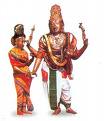
As is the gigantic Universe, so is our Human Body (Yatha Pindae Thathae Brahmandae): In the Indian tradition, through the wedding rituals, the couple for the first time experience invoking the divinity as God and Goddess. To invoke divinity within us means, to identify (realize) the Cosmic principle of changing Sakthi and unchanging Shiva within us. The bride and the groom are also seen as Lord Vishnu and Lakshmi. Lakshmi and Vishnu represent the changing wealth Energy and the unchanging Intelligential factor both in the cosmos and also within ourselves. Married life is a journey to self realize that our real nature is not the mortal body but an miniature of the infinite Cosmic Energy. In the wedding, this ancient Indian Scientific concept is hammered through rituals. The father or the brother of bride, washes the groom’s feet to acknowledge the Cosmic “Maleness” within him.
 After Vaak Daanam (commitment through word) between the elders to guide the couples for a successful married life. The younger generation also honors the experiential marital wisdom of the elders by giving the elders to lead the wedding process. We seek the blessings of our parents and you elders by touching the feet, symbolizing the fact that we want to follow their foot steps of a successful journey together.
Kanya Daanam is done, where the father places the bride’s hand on the groom hand as an act of seeking the commitment to reflect Cosmic order (Dharma) in the married life. Problems in married life is due to lack of understanding and incorporating the Cosmic pattern in our life.
A ritualistic Mangala Snaanam or sacred bath with turmeric and sandal wood paste symbolizing purification of thoughts , which means to give up all our pre-conceived notions of our individuality and learn to accommodate another person’s view into our life. Symbolizing this the bride and groom wear new wedding clothes.
Maangalya dhaaranam istying the Mangala Sutram around the neck of the bride by the groom. Sutra means “Truth” and Mangala means promising success. So Mangala-Sutram or Thaali is an assurance given that the married life promises success in knowing the Truth of life. The thread means to focus or tie the mind onto the Truth.
Mâangalyam tantunânena mama jîvanahetunâ |
kantheh badhnami subhage! sañjîva śaradah śatam ||
This is a sacred thread. This is essential for my long life. I tie this around your neck, O maiden having many auspicious attributes! May you live happily for a hundred years (with me).
In Paani Graham ritual, the groom lowers his right palm and encloses it over the right hand of the bride. This again is the trust of holding each other with unconditional love in a journey onwards. "Un-Conditional" means love born out of performing one’s duties more than the physical liking to the person. In this regards it doesn’t matter, if the couple know each other before marriage or is an arranged marriage. Strengthening un-conditional love (duty bound love) more than the business mode emotional expectation is the key success to married life. Sit and discuss, not emotionally to justify one acts and pinpoint or blame others faults. But hold on to intelligence to be aware of your duties of married life. The concept of acceptance, that is accepting the other person as he or she is and helping that individual to rise from the limitations is the foremost duty to be performed in marriage life by both the partners. Only when the mind has to the attitude of acceptance, the emotional Ego becomes less powerful and then gives way to intellect to strengthen the relationship. By constantly giving more importance to intelligence (duties as a husband and wife), one becomes aware of the Higher Cosmic Self.
Walking seven steps (Sapta padi) psychologically gives a friendship feeling. Instead of being bosses, both should be like friends, sharing the relationship with an open heart. During this ritual, the groom walks with the bride holding hands to the right side of the sacred fire. Knowledge purifies like Fire and so Circambulating fire 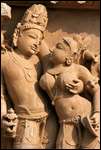 symbolizes a knowledge-centered and driven married life. Both should be aware of the “Freedom” experienced in married life. Freedom does not mean to do whatever to satisfy the emotional urges of the individual but attain emotional independence. Emotional catering and appreciating everytime would be a torture for the other person, spoiling the relationship. Appreciation should be natural and not a conditional requirement and should not be a driving force to perform duties. If a couple achieve this emotional independence and freedom, the unconditional Love of "Radha and Krishna" blossoms.
Traditionally , stepping on a grinding stone, married men wear “Metti” a metallic ring on the toe ring to remind him to walking undeviated path in the married life. He takes the lead of being the model for the family to follow. The groom then points to the sky, the unmoving (unchanging) reference Pole star, the destination of their married life.
Graha Prevesam: This ceremony relates to the journey of the wife and husband to their “Home”. The real home of all of us is the very “Source” (Consciousness) , our real Self. This Journey to the Source is the very purpose of all of us and married life facilitates the process. Both of them enter the house with a lamp signifying knowledge to show the right path.
Final marriage Ritual: From the moment of marriage, both Husband and Wife should live as God and Goddess (Cosmic order). The last ritual is in the private moment of first night. The Husband should prostrate at the feet of Wife to shed his Ego and surrender to the goal of attaining unconditional happiness or bliss with her. The wife  also should do the same ritualistic prostration to the Husband's feet with the same understanding. This is the ideal way to start the married life.
Marital Love-making and Love: Sexual act in non-marital relations is only for pleasure seeking at the body level. Here there is no place for emotional mind, hence it is prostitutional . In the next level of emotional love making, it is an expression of love. Then couple make sex not for body pleasure or to show emotion but to bear a child. this sex is at the logic or intelligence level. The fourth state is the sexual act for transcending to the Awareness state. This is the essence of "Kama-Shastra" .
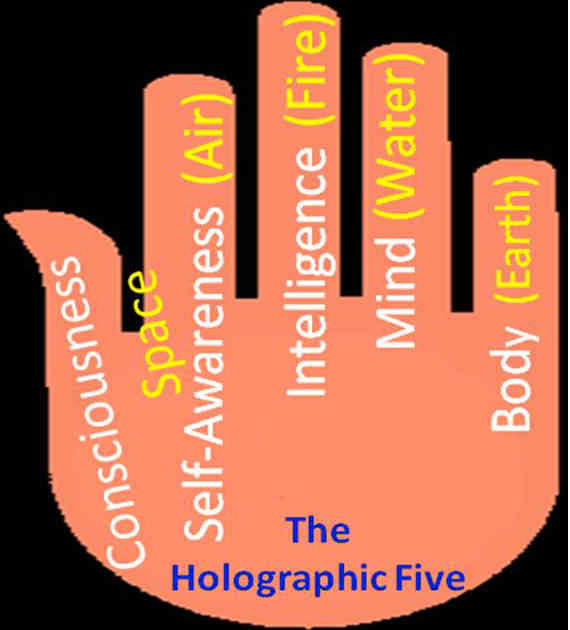 Vaana-Prastham: Most important is to transit from the Second stage of life to the third stage of Vaana-Prastha. This is the stage of implementing the knowledge without being emotionally attached like a Professional doctor or judge. In Vaanaprastham, parents should give incharge to the newly married couple and stay in the background to share and guide through their wisdom and not emotionally attached to the mistakes the younger generation makes in the maturing process. Modern days there is so much of friction between the parents and younger generation because the parents do not proceed from the Graha Ashram to Vanaprastham. If not they will remain unripe sour fruits finding way to old-age homes. Younger generation also should self-correct the ignorant mistakes made by elders.
Why ring worn in ring finger? Earlier, we have explained about Chin Mudra , where the ring finger represents the mind. Marriage is the joining of two minds and so symbolized by ringing the minds. At the End of marriage, the Bridge groom applies thilak to the Bride only using the thumb , because thumb represents "Brahman" the Consciousness. Usually we do not apply tilak to us or others through the fore-finger because it represent "I"-ness or Ego. We use the ring finger as as a symbol of emotional love.
Knowing the meaning as well as awareness of the wedding rituals, will bring happiness in the married life.
We request you to spread this information by giving this as a Thank-you token card by the couple to those who have attended the wedding. We have given here a sample of such a card in this link, feel free to use it acknowledging Sakthi foundation. See here for other language Tamil Thank-you token card.
Other web sources of information on traditional Vedic wedding" and a shorter version describe the significance of the rituals.
Uni5 Saptapadi mantra and meaning
Sapthapadi (Seven vows in the seven steps of Vedic Wedding)
Vows (pratidnya) of the Groom
The Mantra and meaning of the mantra to be chanted by the groom holding the hands of the wife and walking around the fire and then stop and says the first vow. Then continue with the second round and then stop and say the second vow. Do this for the seven rounds.
1. ‘इष एकपदी भव-सामामनुव्रताभव-पुत्रान्विदावहैबहूंस्तेसंतुजरदष्टय: isha eka padi bhava samaamanuvritha , bhava puthraan vindavahe bahun the santhu jara dashtayaha.....।। O bride, you have walked the first step with me. Hence you will nourish my body with healthy food so that it helps to fulfill the highest objectives of life as a family that had lived long as a cultural tradition. (Here puthran represents the new born family which is the off-shoot of the existing long-lived family tradition).
2. उर्जेव्दिपदीभव-सामामनु० ।। urjeey dwi padi bhava O bride, you have walked two steps with me; hence may you become one who will give me strength to our minds.
3. रायस्पोषायत्रिपदी भव० ।। rayasthoshaaya thri pade O bride, since you have walked three steps with me, may you become one who will increase our wealth through good profession.
4. मायोभव्यायचतुष्पदी भव० mayo bhavyaya chathush padi bhava ।। Since you have walked four steps with me may that help in enjoying all four levels of happiness in life.
5. प्रजाभ्य: पंचपदी भव० prajabhya pancha padi bhava ।। Since you have walked five steps with me, may we give birth to healthy children.
6. ऋतुभ्य:षट् पदी भव० rithubhya shad padi bhava।। Since you have walked six steps with me may we walk together through all seasonal changes of life. (Here rithu represents the different changes of ups and down in life like changing seasons).
7. सखासप्तपदीभव० sakhe saptha padi bhavam ।। You have walked seven steps with me, hence you have become the dearest friend of me.
Vows (pratidnya) of the Bride
The bride takes the following consecutive seven vows, one at each step as Sakthi (Prakruthi) addresses Purusha. After the groom holds her hand, she tells the first vow and then walks along with him and then after the first round, he tells the first vow, followed the the bride telling her first vow and both continue to make seccessive seven rounds.
1. त्वत्तो मेऽखिलसौभाग्यं पुण्यैस्त्वं विविधै: कृतै: । देव ! संपादितो मह्यं वधूराद्ये पदेऽब्रवीत् ।। O Lord! I have had the good fortune of joining you due to the various types of merits acquired by me in various births.
2. कुटुंबं पालयिष्यामि ह्यावृद्धबालकादिकम् । यथालब्धेन संतुष्ठा व्रते कन्या व्दितीयके ।। I will look after the entire family, without any discrimination and will be contented always.
3. मिष्ठान्नव्यंजनादिनी काले संपादये तव । आज्ञासंपादिनी नित्यं तृतीये साऽब्रवीव्दरम् ।। I will focus on nourishing the family with healthy food.
4. शुचि: शृंगारभूषाऽहं वाङ्मन: कायकर्मभि: । क्रीडि ष्यामि त्वया सार्धं तुरीये सा वदेव्दरम् ।। I will accompany you with full awareness in all acts done with the body, mind and intelligence.
5. दु:खे धीरा सुखे हृष्टा सुखदु:खविभागिनी । नाहं परतरं यामि पंचमे साऽब्रवीव्दरम् ।।: I will share along with you sorrow of life bravely and remain pleased in happiness and will not deviate from Truth.
6. सुखेन सर्वकर्माणि करिष्यामि गृहे तव । सेवा श्वसुरयोश्चामि बन्धूनां सत्कृतिं तथा ।। यत्र त्वं वा अहं तत्र नाहं वञ्चे प्रियं क्वचित् । नाहं प्रियेण वञ्चा हि कन्या षष्ठे पदेऽब्रवीत् ।।: I will happily perform all household chores staying together with you and will take care of all the family members, relatives and friends with love and respect.
7. होमयज्ञादिकार्येषु भवामि च सहाय्यकृत् । धर्मार्थकामकार्येषु मनोवृत्तानुसारिणी ।। सर्वेऽत्र साक्षिणस्त्वं मे पतिर्भूतोऽसि सांप्रतम् । देहो मयार्पितस्तुभ्यं सप्तमे साऽब्रवीव्दरम् ।। O master! I will assist you in the rituals of sacrificial fires (hom-yadnya), etc. and will follow you with regard to Righteousness (Dharma), wealth (artha) and desire (kama). Here, in the presence of the deity of fire (Agnidev), noble people of high awareness, my parents and relatives, I have accepted you as my friend and guide and lead my life with you together.
- Details
- Parent Category: Rituals
- Category: Social Rituals
- Hits: 11467
Tantric Sex
All rituals are oriented to transcend the Ego.
There are many rituals and one among them is the "Sexual act". In all religious cultures except vedic cutlure Sex is considered sacred because it is one type of ritual which can be used to transcend the Ego and be in the higher Conscious state or God-state.
What is Tantric Sex?: This has been highly been mis-understood. This is purely for husband and wife to transcend their ego-sense complex to the higher Consciousness state, the Shiva-Sakthi Union state.
In a sexual act , it is natural each partner, the husband or wife is keen on deriving maximum pleasure. The "I" thought predominates. The "I" thought is maximum displayed during sexual act, because sexual act gratifies all the five sense organs.
Music gratifies - hearing sense,
Movies gratifies two (audio-visual).
Talking to others is enjoyable because of the three organs involved.
Food gratifies four, taste, touch, visual and smell.
Sexual act gratifies all five senses.
Sexual act with the "I" thought gives only a minor satisfaction, but if done to give the sacrifice of giving maximum pleasure to the partner, in-turn will be rewarded with complete satisfaction. This is one of the basic principle of Tantric-sex.
With this attitude when one engages in sexual act derives total satisfaction and also get to the next step of Tantric-sex.
When one gets detached from the "I" thought, one witnesses the whole process of the enjoyment of the sensorial organs, leading to the transcendental state of complete awareness. This is the state of Shiva-Sakthi Union described in tantric Sex. Shiva is Awareness and Sakthi is the Energy of that Awareness. This is why in Vedic Tradition Sexual act is considered as Sacred and not a sinful act. Through Sex one can experience God-Consciousness or the Supreme Cosmic Consciousness. But this has been abused and used in non-husband-wife relationships. Sexual act other than that of a Husband-wife is not considered as sacred. The Sexual act of a husband and wife transcending their Ego and witnessing the Awareness state is the supreme blissful state one can experience.
Click here to know details of the Kama Sutra information.
Why is only Husband and wife Union considered sacred:
This will be answered in the importance of Marriage page partly. Here we will understand that in Sexual act in non-marital relations, the aim is just body pleasure and not, expression of "Love". In a husband and wife relation where each of them favors the spiritual growth of the other, Love expresses spontaneously and then in their conjugal union they experience the Cosmic Consciousness.
The Vedic tradition of marriage is so beautiful in its rituals, that highlights this aspects. The very purpose of marriage is meant for this union to the highest Self.
Without understanding this greatness , today's marriages are merely meant to satisfy each other's sexual greed, material greed, and social status and to avoid one's personal boredom in life.
It is a sorry state to see, that marriages are not strong because the couples involved into this sacred relation does not understand why this ritual of life is done. marriage is a ritual like any other ritual that is done and described here.
As we have discussed that many rituals are done without knowing the very purpose of it and then it becomes a failure. Marriages are also like that and without that understanding it also ends in failure.
| For more details |
Subcategories
SAL Energy
Rituals and SAL Energy
Rituals in Sanathana Dharma
Festivals in Sanathana Dharma
Rituals in other Traditions
Festivals in other Traditions
CAC
CCC/CAC/Literature
Vedic Literature - English
We have organized this section in the Uni5 pattern
Body-Rituals and Festivals- About symbolism of rituals, festivals
Mind- Slokas-Music-About slokas, sthothras and music ragas
Intelligence-Gods-Scriptures-about the literature of gods.
Awareness-Temples / Pilgrimage- About temples, pilgrimages
Consciousness-Devotees-About the life history of all different devotees, including patriots
Vedic Literature - Tamil
We have organized this section in the Uni5 pattern
Body-Rituals and Festivals- About symbolism of rituals, festivals
Mind- Slokas-Music-About slokas, sthothras and music ragas
Intelligence-Gods-Scriptures-about the literature of gods.
Awareness-Temples / Pilgrimage- About temples, pilgrimages
Consciousness-Devotees-About the life history of all different devotees, including patriots
Vedas Sakthi
Festivals
Pilgrimages
Yathra
Yatra