Uni5 Self Awareness
- Details
- Parent Category: Vedas Sakthi
- Category: Vedic Sciences
- Hits: 9215
Ashtanga Yoga
Ashtanga Yoga is a system of Yoga recorded by the sage Vamana Rishi in the Yoga Korunta, an ancient manuscript. Ashtanga Yoga literally means "eight-limbed yoga," as outlined by the sage Patanjali in the Yoga Sutras. According to Patanjali, the path of internal purification for revealing the Universal Self consists of the following eight spiritual practices:
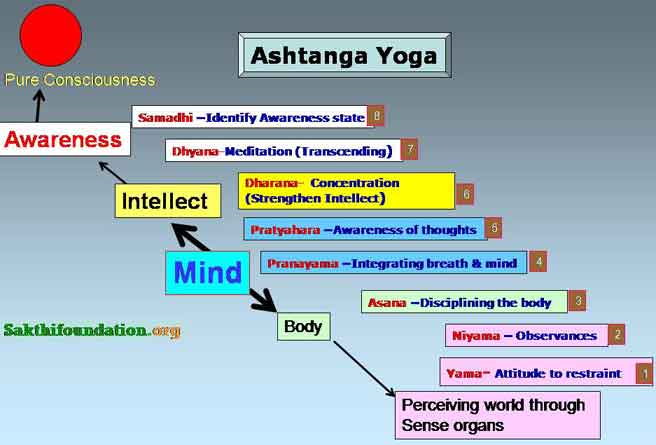
These eight steps follows exactly the same path of body, mind, intellect, to awareness. The aim is to transcend to the Awareness state.
 Discipling the Interaction of Sense organs with world:
Yama - Outward behaviour restraints- Ethical guidelines pertaining to the relationship with others in society, the outer environment, or Nature. All the yamas apply to actions, words, and thoughts. The yama consist of Ahimsa - non-violence, Satya - truthfulness, Asteya - non-stealing, Aparigraha - non-desire and Brahmacharya - moderation.
Niyama: Internal-restraints: Ethical guidelines pertaining to daily activities. Observances of one's own physical appearance, actions, words and thoughts. Niyama include the qualities of- Saucha - purification, Santosha - contentment, Tapas - discipline, Svadyaya - self study and Ishvara Pranidhana - surrender to God (Awareness).
Asana : Discipling the body: seat, correct position i.e. with spine erect & all muscles in the body relaxed.
Pratyahara: withdrawal of senses from their external objects.
Pranayama: control of breath.
Discipling the Mind Pratyahara: withdrawal of senses from the outer world.
Strengthening the Intellect
Dharana: concentration (without any mental wanderings).
Transcending to Awareness
Dhyana: meditation.
Abide in Awareness
Samadhi: oneness with the object of meditation, the Supreme Spirit.
The first four limbs—yama, niyama, asana, pranayama—are considered external cleansing practices in which defects in the external practices are correctable. However, defects in the internal cleansing practices—pratyahara, dharana, dhyana—should be done under the guidance of a teacher, Guru, otherwise it will be wrongly interpreted. The mind tries to interpret in the way it likes and tries to twist the truth for its justification acts. Hence it should be made clear with a teacher or Guru.
- Details
- Parent Category: Vedas Sakthi
- Category: Vedic Sciences
- Hits: 8848
Four Yoga
As we have seen earlier that the core principle of Vedic knowledge is to transcend to the Awareness state and identify that is the real nature of our being. This realization or Union in Sanskrit is known as "Yog". This is the root word for Yoga, which means to be in the Awareness state. As we have discussed earlier that Ego prevents the Transcendence to this Awareness state. There are four main means to transcend the ego. They are - Karma Yoga, Bhakti Yoga, Jnana Yoga and Raja Yoga. Each is suited to a different temperament of the individual or approach to life. All the paths lead ultimately to the same destination - to union with Brahman or Consciousness.
Karma Yoga, The Yoga of Action
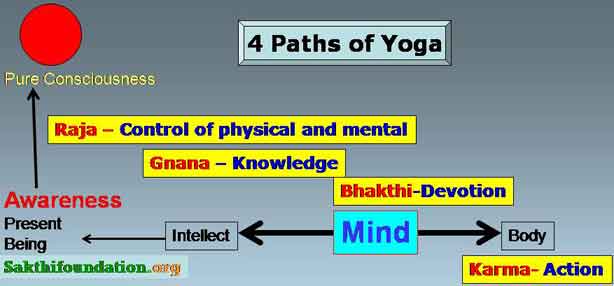
Everyone are engaged in action always. But the Ego which is a single "I" thought takes the credit for all actions. Being aware of this Ego thought, one attributes the results of all actions to the awareness. This is the easiest means to sublimate the Ego and transcend to the Awareness state. This is the path chosen primarily by those of an outgoing nature. It purifies the heart by teaching one to act selflessly, which means not for the Ego. To achieve this, it is helpful to keep the mind focused by repeating a mantra while engaged in any activity.
. . 
Bhakti Yoga, The Path of Devotion or Divine Love
The Karma Yoga is for mankind involved in action. When an individual has matured in that Karma Yoga, he slowly gets into the next state of maturing his mind, called Bhakthi Yoga. This path appeals particularly to those of an emotional nature. The Bhakti Yogi is motivated chiefly by the power of of Love and sees God (Awareness) as the embodiment of love. Love is the nature of Awareness means to be united in Awareness.
Through prayer, worship and rituals an individual surrenders the emotions into unconditional love or devotion. Chanting or singing the praises of God form (Awareness) a substantial part of Bhakti Yoga. In one examines the praises of God, it is basically honoring the qualities of Awareness.
Jnana Yoga, The Yoga of Knowledge or Wisdom
This is the most difficult path, requiring tremendous strength of will and intellect. This occurs only when the individual has matured his or her mind and strengthens the intellect. Taking the philosophy of Vedanta, the Jnana Yogi uses his mind to inquire into its own nature. We perceive the space inside and outside a glass as different, just as we see ourselves as separate from (Awareness) God. Jnana Yoga leads the devotee to experience his unity with God directly by breaking the glass, dissolving the veils of ignorance. Before practicing Jnana Yoga, the aspirant needs to have integrated the lessons of the other yogic paths - for without selflessness and love of God, strength of body and mind, the search for self-realization can become mere idle speculation.
Raja Yoga, The Science of Physical and Mental Control
Often called the "royal road" it is the integration of the faculties of body, mind, intellect and Awareness. This method offers a comprehensive method for turning our mental and physical energy into spiritual energy (Awareness). Raja Yoga is also called Ashtanga Yoga referring to the eight limbs leading to absolute mental control. The chief practice of Raja Yoga is meditation. It also includes all other methods which helps one to control body, energy, senses and mind to transcend to the awareness state.
- Details
- Parent Category: Vedas Sakthi
- Category: Vedic Sciences
- Hits: 13380
Pancha Bhootas
In the Previous page, we have discussed that this Universe is the manifestation of pure Consciousness.
The pure Consciousness is known as Purusha (Spirit) or Male energy (symbolized as upright triangle). The male energy or Purusha does not undergo any change but has an ability to project as though it undergoes changes. This ability is called "Sakthi" (Energy-Matter) or the female energy (symbolized as downward Triangle).
It is only the female energy that manifest as the Universe. However the female energy manifested as universe (matter) has no independent existence without the Purusha (Spirit or Consciousness). So all the forms that we see in this Universe has both male-female aspect in it.
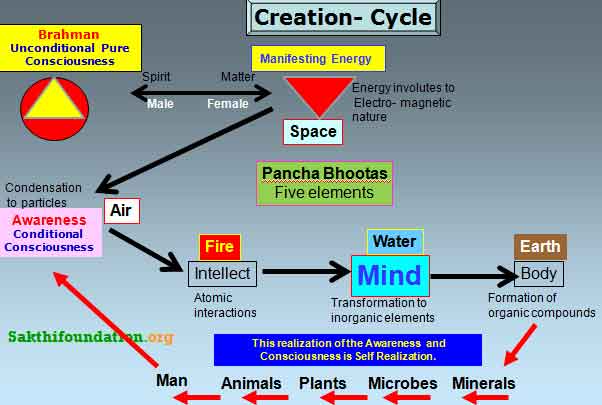
The subtlest Female energy functions as
1. Creative-energy,
2. Maintenance-energy and
3. Dissolution energy.
These three functions aspects of the subtle-Energy (Sakthi) materializes as the gross-matter (Universe) through five laws or principles. They are known as Pancha Bhootas, the five underlying principles which bring forth material-forms (Bhoota or Bhuta).
1. The first principle that aids the subtle-Energy (Sakthi) to expand or project as matter is called as the Space principle or (Aakasha element). The Energy at this stage exists as subtlest electromagnetic wave energy. This is the manifestation/expansion phase in the manifestation of Universe.
2. The second principle is the condensation phenomenon, that aids the wave like energy to condense to particle form. This is the Air principle(Vaayu element) .
3. The third principle is the interactive phenomenon, the Fire element (Agni), that which ignites or that brings about interactions among the particles.
4. The fourth principle is the transformation principle which means it flows or converts into different forms. Interactions among particles results in conversion to various elements. This is called the water element (Jalam) or the flowing aspect.
5. The fifth principle is the combinational aspect or Earth principle (Prithvi) or gross element. The combination of the solid compounds formed resulting in the manifestation of many living and non-living forms.
The One Consciousness is behind the manifestation of the Universe through the five principles (Pancha Bhootas). This five principles are seen in each and every atom to the entire universe and also the theme behind all Vedic Sciences, especially in Pancha Bhoota healing and Ayurveda.
In Vedic tradition everything is of two dimension, the subtle and gross (the inner and the outer). The five elements (Pancha Bhootas) at the subtle level are the five basic principles in the manifestation of the Universe. At the gross level they can be understood as the literal Space, Air, Fire, Water and Earth. However, over years only the gross aspect of the Five elements were only taken into account which has led to severe misinterpretation and errors. This is because the basic Vedic Truth or Principle is not understood.
When the very Fundamental Vedic Knowledge is misunderstood, literal meaning is conceived leading to ignorance. This misunderstanding has spread to all branches of Vedic Sciences leaving Vedic Science as mystic or even superstitious cult. Mission of Sakthifoundation is to bring out the the highest Truth of Vedic Tradition, which is common to both modern science and traditional spiritual disciplines. This new perspective bridges and unites the two opposing cultures of religion and science. Now let's move on to the next level of understanding the creation of the Universe.
Click the link if you interested to know more about Pancha Bhoota healing of diseases. Otherwise please continue reading about the manifestation of Universe.
Navagrahas (Nine planets):
This five principles (Pancha Bhootas) behind the manifestation of this universe has nine aspects of expression. This nine aspects of expression of the five Pancha Bhootas are the Navagrahas. Navagrahas like the Pancha Bhootas are literally taken as the outward gross planets of the Solar System. This cause severely damaged the credibility of another branch of Vedic Science, Jyothism.
Other views
http://swamiindology.blogspot.com/2014/12/who-discovered-five-elementspancha-bhuta.html
http://bhargavasarma.blogspot.com/2012/07/symbolism-significance-of-number-five.html
https://auromere.wordpress.com/2011/05/19/pancha-mahabhutas-the-five-subtle-constituents-of-matter/
- Details
- Parent Category: Vedas Sakthi
- Category: Vedic Sciences
- Hits: 32705
Vedic Creation Cycle
The whole Universe is only a manifestation of Pure Consciousness. There is no concept of creation in Vedic tradition. This is how the Vedic tradition is different from all religions. Science talks about creation too, but what triggered creation and how the big-bang originated is the unanswered question for modern science.
According to Vedic tradition, there is no "God" (a person) sitting in the skies and creating and controlling everyone and everything. There is no creation of this universe but only manifestation. If it is a creation, then there is a creator who is different from the raw material he or she uses and also different from the created end-product and also there is purpose for it. Then endless questions appear like where did the raw material come from for the creator to create the universe etc.
According to Vedic Science , there is only manifestation, which means that the creator, creating material and the end product of creation are all one and the same. That "oneness" non-duality is the core of Vedic tradition and not only do not contradict with any "Truth" seen in other religious/spiritual traditions but also in tune with the discoveries of Modern science.
Since the "One" is manifested in the universe as several with a unique phenomenon, there is that common fundamental aspect reflected in everything. Only by understanding this fact, one can understand the core theme of all branches of Vedic sciences. Whether it is a dance or a ritual or medical science of Vedic science, all reflect this one fundamental Truth in it. The "One" that Vedic tradition talks about is the Pure Consciousness.
How Consciousness manifest as the Universe?
The ancient Vedic science clearly explains how the the whole Universe is the manifestation of from Pure Consciousness. This process of manifestation is observed at the macro-cosmic level and also at the individual micro-level. The process of manifestation is also the underlying fundamental common theme of all the Vedic sciences.
The pure Consciousness is known as Purusha (Spirit) or Male energy (symbolized as upright triangle). The male energy or Purusha does not undergo any change but has an ability to project as though it undergoes changes. This ability is called "Sakthi" (Energy-Matter) or the female energy (symbolized as downward Triangle).
It is only the female energy that manifest as the Universe. However the female energy manifested as universe (matter) has no independent existence without the Purusha (Spirit). This is why Adi-Sankara said Brahma Sathya Jagath Mithya. This means this Consciousness is real but the Universe is un-real.
The term "un-real" has been wrongly misunderstood as illusion. The Universe is not an illusion.
The whole confusion goes away by understanding four words.
1. Sathya (Real). Consciousness is Sathya (Truth or Reality). This means it exists by itself. It does not need anything for its existence.
2. Mithya (unreal, asath)- Anything that is not self-existent but depends on something else. For example, if Gold is taken as real, then Gold ring and gold necklase is mithya or unreal. Unreal does not mean illusion. Gold ring is not an illusion, but mithya. This means the ring (form) necklase (form) depends on Gold for its existence. If there is no gold, there is no Gold ring or Gold-necklase. So they are mithya.
3. Thutcha (illusion). Horse horn is an illusion. It never exists. This is clear and does not require further explanation.
4. Maya. Maya is the inability to distinguish between the real (sath) from Asath (unreal). Maya is wrongly translated as illusion. Maya is not illusion. It is the lack of awareness to understand the real from the unreal. (to read more about "Maya" click)
Therefore this Universe is not an illusion (thutcha) but Mithya (unreal). Only Pure Consciousness is real.
With this understanding let us proceed further to understand the manifestation of this universe. There are five major principles bringing forth this manifestation. These underlying principles which bring forth Bhoota (Bhuta) (form) are five in number. They are known as Pancha Bhootas, the five principles.
- Details
- Parent Category: Vedas Sakthi
- Category: Vedic Sciences
- Hits: 9608
Worlds in this Universe
The cosmological sciences of Puranas reveal the fact that infinite universes are continously formed and dissolved. There is no end, it is eternal. Modern science also is understanding this truth. The vieo below is a good animation of how the universe is contracting and expanding at the same time.
The cosmography of the Puranas describes the astronomical Universe of the solar system and the fourteen worlds, of which six are said to range above the Earth-plane and seven below it. The Earth-plane itself is said to consist of seven continents and seven oceans, all concentric in their arrangement, every succeeding continent and ocean being double the preceding one in extent.
There is a detailed geographical description of our own earth, with its mountains, rivers and holy shrines. There is also a calculation which states that among the five elements - Earth, Water, Fire, Air and Ether - every succeeding element is ten times the preceding one in largeness. Apart from the superphysical existence of these wonder-striking planes, this description of the cosmos suggests its incredible vastness, all which is supposed to be a very insignificant part of the glorious manifestations of God.
The entire possibility of experience in life has been terraced by the rsis into fourteen worlds; seven higher lokas and seven lower worlds. There are three worlds in which a limited ego-centre comes to play its game of reincarnation and repeated deaths: these are (1) Bhur-loka, the physical earth; (2) Bhuvar-loka, the world next to the physical and closely connected with it, but constituted of finer matter; and (3) Suvar-loka, the heavenly world. Beyond these are the four other 'worlds' wherein the ego comes to move about and enjoy in its higher evolutionary life, and they are called the Mahar-loka, Jana- loka, Tapa-loka, and Satya-loka.
we also find conceptions of other 'worlds' such as Indra-loka, Candra-loka, Surya-loka, Pitra-loka, etc., which are special 'realms of experiences' located within the above regions.
Below these seven 'worlds' there is yet another set of seven 'worlds' called the talas. They are named as Pa-talam, Maha-talam, Rasa-talam, Tala- talam, Su-talam, Vi-talam, and A-talam.
Of these fourteen 'worlds', Bhur-Bhuvar-Suvar, denoting the 'three worlds', are called the vyahrtis. In the Gayatri Mantra, when these vyahrtis are chanted, the meditator can visualise the 'three worlds' as arising from, existing in, and disappearing into AUM. He can subjectively identify them with the waking, dream, and deep-sleep conditions of consciousness, transcending which extends the realms of the Infinite. All of them are represented in the symbol OM. In this sense, the vyahrtis in the Gayatri represent in one sweep the entire 'world' of the subjective and the objective experiences of man.
Excerpted from Swami Chinmayananda, Courtesy of: Vishvarupa.com
Web sites that give further interesting information on the 14 worlds.
Orange theory- Shape of Universe, Universe simulataneously expanding and contracting
Subcategories
SAL Energy
Rituals and SAL Energy
Rituals in Sanathana Dharma
Festivals in Sanathana Dharma
Rituals in other Traditions
Festivals in other Traditions
CAC
CCC/CAC/Literature
Vedic Literature - English
We have organized this section in the Uni5 pattern
Body-Rituals and Festivals- About symbolism of rituals, festivals
Mind- Slokas-Music-About slokas, sthothras and music ragas
Intelligence-Gods-Scriptures-about the literature of gods.
Awareness-Temples / Pilgrimage- About temples, pilgrimages
Consciousness-Devotees-About the life history of all different devotees, including patriots
Vedic Literature - Tamil
We have organized this section in the Uni5 pattern
Body-Rituals and Festivals- About symbolism of rituals, festivals
Mind- Slokas-Music-About slokas, sthothras and music ragas
Intelligence-Gods-Scriptures-about the literature of gods.
Awareness-Temples / Pilgrimage- About temples, pilgrimages
Consciousness-Devotees-About the life history of all different devotees, including patriots
Vedas Sakthi
Festivals
Pilgrimages
Yathra
Yatra