Health Section
- Details
- Parent Category: Earth Therapy
- Category: Eating Habits
- Hits: 10318
Four Personalities
Three modes create four different personalities based on a lifestyle of food habits.
1. A person who gives primary importance to the health aspect of food and only secondary importance to his personal likes and dislikes and least importance to the inconvenience of making the food is the first personality. For him thought (Satva) is important, followed by the action mode of taste (Rajas) and then, last, comes the (inconvenience of making the food (Tamas). This person ofSatva-Rajas-Tamas is known as a Brahmin. He always enquires about or analyses the food he eats and attributes to the purpose of food as to provide holistic nourishment to the body. This type of person will eat whole grains, fruits and vegetables, nuts which will nourish his body and avoid refined products which caters to the taste of the tongue. So any fresh, unrefined holistic food prepared and eaten with the understanding (knowledge) of nourishment is Satvic food.
2. The second personality type is a Rajas-Satva-Tamas type who gives primary importance to taste and only secondary importance to health and third to the (inconvenience of preparation. He is a Kshatriya, one who gives action to his tongue and power to sensory organs. Foods that are spicy, salty using fresh produce and non-vegetarian foods are Rajasic foods.
3. The third personality is a Rajas-Tamas-Satva, who is concerned about tasty food but prepared conveniently without paying much attention to healthy thoughts. This person is a Vaishya. Foods that are prepared spicy, salty, oily but prepared using foods that are precut, frozen and micro waved. Here, taste and convenience of food preparation is the main consideration.
4. Tamas-Rajas-Satva. This personality is so lazy that he prefers to compromise even taste for laziness. Such a person is a Shudra. Pre-cooked foods, micro waved and left over foods are Tamasic in nature. There are a few who cook one recipe in a large quantity for a month and divide it into 30 zip-lock bags and deep freeze it. They eat one packet daily and do not mind such routine, tasteless food. They care neither about taste nor think about health.
Why Different Personalities?
This classification of personalities is not intended to discriminate or criticize anyone. It is necessary for our own self awareness. We learn to identify our own personality and can learn to change it if we so wish. Our objective is to bring peace. This is possible only if we try to reduce mental agitations. This, in turn, can be obtained only through discipline in life. Since food is one of the most important factors in life, the type of food we eat becomes important to achieve our objective. Food abuse or overeating is something that becomes difficult to control in general. Why? Because it involves four senses.
Please click here to continue reading.
- Details
- Parent Category: Earth Therapy
- Category: Eating Habits
- Hits: 11780
Inner Farming
In the book, One Straw Revolution, the Japanese farmer gives a powerful strategy to avoid the growth of weeds in the farm. He observes the timing of the growth of weeds. Weeds, too, have a season. The farmer sows the seeds for his crop and allow them to germinate just before the seeds of weeds sprout. Since the weeds do not find a favorable environment (strong competition from crops) they remain dormant. So Masanobu Fukuoka avoids the use of herbicides to overcome weeds. Instead he uses Time to his advantage - the right time to plant his field.
If weeds are like negative thoughts and crops the desired positive thoughts, then one has to overcrowd the mind field with positive thoughts. As we discussed earlier, for this the intellect is our only help. For this, Discipline is required. We had started with water therapy as a discipline for growing positive thoughts in us. Next, we should use eating habits as a means of disciplining the mind. Not only do we get immense physical health benefits, ultimately we get to exercise a powerful control over the mind.
Mind is the soil which allows the growth of both weeds and good crops. Undisciplined minds are like the uncultured farm where all sorts of weeds grow with very little yield of desired crops. Depression and all other psychological problems are the results of prolonged cultivation of negative thoughts. We might have scientific proof of genetic influence over the diseases of the mind, but we should not forget that we have will power or freewill that no other being enjoys in this world. Prevention is better than cure. These psychological problems can be cured by growing positive crops in a timely manner along with constant watching out for weeds to be curbed away.
Using anti-depressants and medications is similar to using herbicides to thwart weeds. It poisons the entire soil and is not a permanent solution. To avoid depression and psychological problems one has to grow positive thoughts.
Garden of Life
The fostering of positive thoughts is the fundamental aspect of Pancha Bhoota healing. The physical health benefits it offers is only a side package like the beauty of flowers in a farm. The real benefit of the farm is the fruit the we enjoy in the end. Similarly, the real benefit of Pancha Bhoota healing is the fruit of freedom of the mind.
Since this section is about Earth as an element of healing, we will discuss how through eating habits we can gain control over the mind.
Please click here to continue
- Details
- Parent Category: Earth Therapy
- Category: Eating Habits
- Hits: 10939
|
 |
|||||||
|
||||||||
- Details
- Parent Category: Earth Therapy
- Category: Eating Habits
- Hits: 12674
Non-Vegetarian Diet
Whether a non-vegetarian diet is good or bad is a most frequently asked question and the most debated topic in forums about diet. Since a lot of information is available on the benefits of being a vegetarian, we are only highlighting them. We will discuss these with relation to our mind.
1. A vegetarian diet is healthier than a meat based one.
2. More energy and earth resources are needed to grow meat (animals) than plants foods.
3. Animals have a higher mind development and so exhibit much fear when approached for killing.
Mind and Non-Vegetarian Food
The mind is restless by nature and this is further intensified by eating non-vegetarian food. The mind and intellect of plants is less developed than of animals and so the agitations of the mind are much less in plants. Mental agitations are expressed as chemicals in the form of stress hormones which are seen in a higher degree in animals and very less in plants. Since we are interested in decreasing mental agitations for health reasons, spiritual development and finally peace of mind, eating plant based foods helps us in our pursuit more than meat foods.
Often our sense of taste is addicted to food and we lose control over our mind. Consuming meat further intensifies this addiction. You can experiment how, by switching over to plant based foods, you gain better control over your senses and mind. It has to be very clear that just vegetarian food alone cannot bring mind control, but the point is that it facilitates it strengthening the intellect and pulls the mind towards it and away from the senses.
This is why in most spiritual traditions, vegetarian food is recommended. More than health, ethical and economical reasons, the most important aspect is that vegetarian food helps in strengthening the control over the restless mind. (Read about five reasons not to eat meat)
https://learn.uvm.edu/foodsystemsblog/2014/07/10/meat-vs-veg-an-energy-perspective/
Different foods require different amounts of energy to produce. Meat is four times as demanding as grains are. If consumers would gravitate toward less intensive foods, energy use would drop. Reducing the enormous amount of food that is wasted would save energy as well. Check out the data and commentary below, expanding on "More Food, Less Energy" in the January 2012 issue of Scientific American
Hidden animal products in many foods
Specific brands with animal products
Fish oils in many veg foods- Beaware
Please click "Next" on the right side to continue reading.
- Details
- Parent Category: Earth Therapy
- Category: Eating Habits
- Hits: 11539
Tongue
We have five sense organs - eyes, nose, ears, skin and tongue. It is very interesting to note that all our sense organs, except the tongue, are in duplicate: i.e. two eyes, two ears, two nostrils and the whole area of skin from head to toe to sense touch. But we have ONLY ONE tongue!
Also the four organs have only one function each. But the tongue has TWO functions. Taste and Speech. Tongue is the sense organ that invites the most trouble, both through taste and speech! We talk hurting words and invite trouble. If the tongue is not under control, we do not know how much to talk, when or where. Similarly, with the tongue we do not know how much to eat, nor the time or place. We let lose the tongue without any control for either taste or speech. Without keeping the tongue in control, we overeat. Because of lack of control, we eat and drink things that are harmful to the body.
It is an irony that we want to be healthy, slim without having control over the body. This is as good as wanting to jump in the water without getting wet. Again we do not tell you not to eat tasty food. Food is also to be enjoyed but we need a control over the enjoyment otherwise it creates massive problems for us.
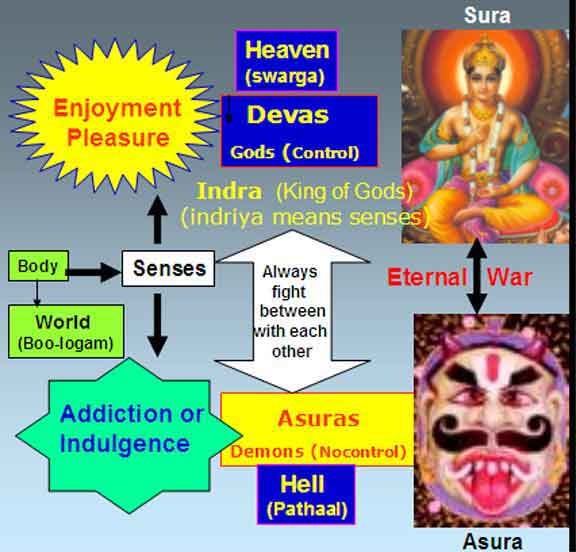
In Vedic tradition the pleasure of enjoying the senses (Indriyan) is called Swarga which means heaven. This is ruled by Indra, who is a Deva or God. But when the sense enjoyment goes into excess or addiction it is called Asura or demon and hell is their abode. Sura means to be a leader or have control over. "A" is a prefix to denote "no" and so Asura refers to someone who has no control. Generally, the battle between the Asuras and Devas is taken literally. But the ancient masters have conveyed the message through these beautiful illustrations; how in every sensory enjoyment there is always an internal battle between enjoying and indulgence.
Please click here to continue