Vedas Sakthi
- Details
- Parent Category: Vedas Sakthi
- Category: Vedic Sciences
- Hits: 9550
Ayurveda-2
It is rightly said that Ayurvedic treatments even cure Karmic diseases. When a traditional Ayurvedic treatment is given as explained here the individual changes his thought processes. When the thought processes are changed actions are changed. Change in actions changes Karma of the individual. Such is the simple understanding of this great Health science. Disease according to Ayurveda is an expression of one's karma to be corrected. Physical disease warrants the attention that the Individual needs to his Awareness to the next higher level. It is the stepping stone to the next level of Evolution.
Modern scientific research gives the very logical understanding that the diseases are caused through defective expression of the genes, which in turn is influenced by life style of the individual which includes the food eating habits. Unfortunately Modern science focused only on the body and so have left it unaware of the deeper implications of the Mind that Ayurveda explains. We will now go to the details of the Mind and the Cosmic laws operating at the Universe level and the Individual level.
The five Pancha Bhoota principles of Expansion, localization, Interaction, transformation and combinations at the Cosmic level also operate as the five senses in the body. This is how the individual body is connected to the Cosmic level. Our sense organs are not mere organs of the body, but the very tools to experience the Cosmic phenomenon. The Indriyas (Senses) act as a bridge between the mind and the physical world outside. Primary cause of disease is the improper use of the senses, Insufficient sensory inputs and the emotional imbalance it causes.
Ayurveda understands that it is the nature of the mind that is the root cause of sufferings and diseases. Hence to settle the mind, it also employs the use of Yoga and Meditation. Like other Vedic disciplines it also incorporates spiritual aspect in the individual. A very traditional Ayurvedic Vaidya (doctor) uses pulse diagnosis through which he or she understands the functioning of the body.
| Reflects | Tridhoshas | Senses | perception Organ | Action | |
| Aakash-Ether | Expansion | Vaata | Hearing | Ear | Hearing |
| Vayu-Air | localization | Vaata | Touch | Skin | Holding |
| Agni-Fire | Interactions | Pitta | Vision | Eye | Walking |
| Jala-Water | Transformations | Kapha | Taste | Tongue | Procreation |
| Prithvi-Earth | Combinations | Kapha | Smell | Nose | Excretion |
Other interpretations
Insights from Ayurveda for translational stem cell research
Kalpana S. Joshi and Ramesh Bhonde
http://www.ncbi.nlm.nih.gov/pmc/articles/PMC4012361/?report=reader
Ayurveda physiology explains a dynamic exchange between in terms of continuous regeneration of tissues. The tissues undergo continuous process of destruction and regeneration. The homeostasis is maintained by Doshas, those regulate all the metabolic processes. Vata regulates the catabolic activity (tissue wear and tear), Kapha stimulates synthesis of newer tissues, and Pitta governs the process of nutrients assimilation into tissues. Dosha act through body tissue, Ayurveda terms those as Dhatus (Sanskrit meaning to hold or withstand). Ayurveda recommends several dietary, lifestyle, and herbomineral interventions for Dosha balance and Dhatu nourishment resulting in healthy long life. Traditionally therapies such as Panchakarma and Rasayana are used in Ayurveda for rejuvenation. Current knowledge on adult and embryonic stem cells if used along with concepts of regeneration in Ayurveda can contribute to the development of regenerative medicine with integrative approach
STEM CELL BIOLOGY
Stem cell research is being pursued in the hope of achieving major medical breakthroughs in treatment of diseases. Stem cells are self-renewing, unspecialized cells that can give rise to multiple cell types of all tissues of the body. Somatic or adult stem cells typically generate the cell types of the tissue in which they reside. For example, a blood-forming adult stem cell in the bone marrow normally gives rise to the many types of blood cells. It is generally accepted that a blood-forming cell in the bone marrow—which is called a hematopoietic stem cell—cannot give rise to the cells of a very different tissue, such as nerve cells in the brain. Experiments over the last several years have purported to show that stem cells from one tissue may give rise to cell types of a completely different tissue, a phenomenon known as plasticity. Examples of such plasticity include blood cells becoming neurons, liver cells that can be made to produce insulin, and hematopoietic stem cells that can develop into heart muscle. Therefore, exploring the possibility of using adult stem cells for cell-based therapies has become a very active research area.[20]
In recent years, several lines of evidence have suggested that adult stem cells are multipotent and can differentiate into different cell lineages. Adult bone marrow, brain, skeletal muscle, liver, pancreas, fat, skin, and skeletal muscle, have all been shown to possess stem or progenitor cells with the capacity to differentiate into cell types other than their tissue of origin.
Studies with bone marrow stromal or MSCs, a subset of cells that can be separated by plastic adherence, have shown differentiation into various cell types, including bone,[21,22] tendon, cartilage, and fat.[23] Stem cells, directed to differentiate into specific cell types, offer the possibility of a renewable source of replacement cells and tissues to treat diseases including Parkinson's and Alzheimer's diseases, spinal cord injury, stroke, burns, heart disease, diabetes, osteoarthritis, and rheumatoid arthritis.[24]
BIOMEDICAL INTERPRETATION OFDHATU
Ayurveda mentions about emergence of various Dhatus in a sequence such as “Rasa, Rakta-Mamsa, Meda, Asthi, Majja, and Shukra”.[29] These Dhatus develop sequentially and nourish further Dhatus. For example, Rakta Dhatus plays important role in formation of Mamsa, which further nourishes Meda. The concept of Dhatus from Ayurveda and that of
modern biology are different, but can be interpreted according their descriptions and functions. These Dhatus cannot be directly equated to various tissues; however, each tissue is formed by composition of many Dhatus. Respective Dhatus are dominant in specific tissues. There is a possibility that there is presence of stem cells in a particular tissue (Dhatu) giving rise to the next Dhatus in sequence.
Adult bone marrow stromal cells are shown to differentiate into neural cells in vitro by treating them in presence of epidermal growth factor (EGF) or brain-derived neurotrophic factor (BDNF), expressed the protein and mRNA for nestin, a marker of neural precursors.[20] Human adipose tissue obtained from liposuction procedures has also been used to isolate a fibroblast-like cell population, called processed lipoaspirate (LPA) cells. In vitro studies with LPA cells demonstrated differentiation into adipogenic, chrondogenic, myogenic, and osteogenic cells.[30] Ayurvedic concept of Dhatu needs to be explored on this background. The focus of Ayurveda intervention is to protect and nourish Dhatus to form healthy body is similar that of modern medicine. Unlike Prakriti, which is permanent composition of Doshas, Dhatu concept is dynamic and changes according to diet and drugs. The quality and quantity of Dhatus can change with Rasayana and the depleted Dhatus could be nourished. Thus, the Dhatu concept is the foundation of Rasayana therapy and regeneration of tissues. It is interesting to note that the description of Dhatus fromRasa to Shukra require different dosage forms ranging from aqueous to medicated oils or ghee.
We propose specific Rasayana with appropriate extract and formulation for its effects on stem cells. The experiment can also consider the variations of extracts according to the nature of Dhatus (cell type)
- Details
- Parent Category: Vedas Sakthi
- Category: Vedic Sciences
- Hits: 32707
Ayurveda
Like all the branches of the Vedic Sciences, this health science is also follow the fundamental principle of the Vedas that this Universe if the manifestation of pure consciousness. There are five major principles bringing forth this manifestation. These underlying principles which bring forth Bhoota (Bhuta) (form) are five in number. They are known as Pancha bhoota, the five principles.
The "One" Consciousness is behind the manifestation of the Universe through the five principles (Pancha Bhootas). This five principles are seen in each and every atom to the entire universe and also the theme behind all Vedic Sciences, especially in Pancha bhoota healing and Ayurveda.
Genome-wide analysis correlates Ayurveda Prakriti
http://nopr.niscair.res.in/bitstream/123456789/19358/1/IJTK%202%282%29%20159-169.pdf
Ayurveda is a much deeper health science than the modern science. Modern science takes into consideration only the physical body. Whereas Ayurveda takes into the four aspect of Body, Mind, intellect and the Awareness of the individual. Based on this the individual is given treatment. In short Ayurveda takes into the Karmic aspect of the individual along with the other Vedic Sciences branches like Jyothism (Astrology).
Ayurveda the most complete Health science.
Ayurveda is not just eating or drinking a Herbal preparation or just rubbing a herbal oil on the body. It has a deeper understanding on the Human Anatomy, Physiology, Biochemistry and Genetics in relation to the individual and the Universe. This what makes Ayurveda totally different from Modern medicine from its limitations of looking body symptoms and not holistic.
We have discussed in Jyothism that an individual thought process manifest as Karma of an individual. This affect the health also like how Genetic make up influences the overall health of the Individual. Only recently Modern science have understood that Plants can Consciously change their Genetic's. Ayurveda says this is also possible for humans which Modern sciences has yet to discover for itself.
Ayurveda is holistic that it take the Human body along with the Universe, because Human body operates with the same laws that the Universe also operates. (Read "Yatha Pindae , Thatha Brahmandae"). Ayurveda sees all the Cosmic laws of the Universe that operates in the individual human body. The core theme of Vedic science is that the Energy aspect of the Consciousness manifest as the Universe, through three main functions of Creation, Maintenance and dissolution. This is also the core theme of Ayurveda called the Tridosha theory of Ayurveda.
The Tridosha theory is unique to Ayurveda. It is fundamentally three types of basic activities of creation or anabolic (Kapha), catabolic (Pitta) and metabolic -dissolution (Vata). These three actions are needed for healthy functioning (Homeostasis) of the body. These are like the three legs of a stool. Anyone more or less will cause an imbalance. When there is a disharmony in any of three functions, results in diseases. This is influenced by various aspects like the mind status of the individual, the type of food he or she eats, the environment (place and weather) and his Karma (cause and effect of his or her actions).
Karma is much more a broader word to be used. Genetics is just one part of the Karma. The genetic make up , which means why one individual is born to a set of parents acquiring a set Genetics is based on Karma, called prarabhada-karma (fate). That cannot be altered. But the expression of the Genetics can be altered to a great extent by Agama Karma or destiny. Without this Understanding Ayurveda cannot be completely be effective.
One is given freedom to express the Genetic make up or alter the Genetic expression of the system. Instead of a superficial Gene therapy like Genetic change , the Genetic expression at the Molecular level is what that is changed through Ayurveda. Through Various herbal preparations and also Mind and body exercises an individual can attain a desired health changes. Earlier intervention and prevention is better than treating at the final disintegrating level.
Like Vedic Spiritual science, Ayurveda treatment also starts with a purification step called Pancha Karma. Purification is very very important for any treatment to be effective. We have seen in the Vedic Purification section the importance of Purification. Purification means to bring to Awareness and involves the aspect of Intellect, mind and body as well. At the body and level , purification means to remove unwanted material. At the Mind level it means remove unwanted negative thoughts. At the intellect level it means to strengthen the thoughts and action that help to transcend to the Awareness state, the state of "Being".
six-ayurvedic-herbs-every-doctor-should-know
Greatness of Ancient Ayurveda and exposing the fraud in modern commerical ayurvedic medicines.
http://keralaplants.in/medicinal-plants-in-kerala.aspx
1. Tinospora cordifolia Guduchi chitramruthu seenthil kodi . Tinospora cordifolia: One plant, many roles
http://www.keralaayurvedics.com/category/ayurveda-principles/tridoshas
A comparison of the antioxidant property of five Ayurvedic formulations commonly used in the management of vata vyadhis https://www.ncbi.nlm.nih.gov/pmc/articles/PMC3326791/
- Details
- Parent Category: Vedas Sakthi
- Category: Vedic Sciences
- Hits: 9215
Ashtanga Yoga
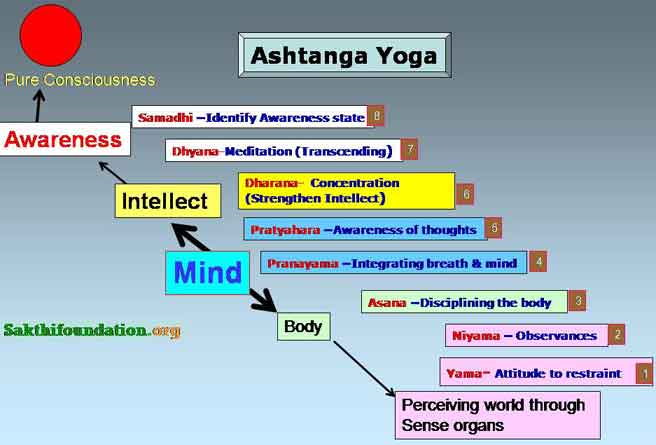
Ashtanga Yoga is a system of Yoga recorded by the sage Vamana Rishi in the Yoga Korunta, an ancient manuscript. Ashtanga Yoga literally means "eight-limbed yoga," as outlined by the sage Patanjali in the Yoga Sutras. According to Patanjali, the path of internal purification for revealing the Universal Self consists of the following eight spiritual practices:
These eight steps follows exactly the same path of body, mind, intellect, to awareness. The aim is to transcend to the Awareness state.
 Discipling the Interaction of Sense organs with world:
Yama - Outward behaviour restraints- Ethical guidelines pertaining to the relationship with others in society, the outer environment, or Nature. All the yamas apply to actions, words, and thoughts. The yama consist of Ahimsa - non-violence, Satya - truthfulness, Asteya - non-stealing, Aparigraha - non-desire and Brahmacharya - moderation.
Niyama: Internal-restraints: Ethical guidelines pertaining to daily activities. Observances of one's own physical appearance, actions, words and thoughts. Niyama include the qualities of- Saucha - purification, Santosha - contentment, Tapas - discipline, Svadyaya - self study and Ishvara Pranidhana - surrender to God (Awareness).
Asana : Discipling the body: seat, correct position i.e. with spine erect & all muscles in the body relaxed.
Pratyahara: withdrawal of senses from their external objects.
Pranayama: control of breath.
Discipling the Mind Pratyahara: withdrawal of senses from the outer world.
Strengthening the Intellect
Dharana: concentration (without any mental wanderings).
Transcending to Awareness
Dhyana: meditation.
Abide in Awareness
Samadhi: oneness with the object of meditation, the Supreme Spirit.
The first four limbs—yama, niyama, asana, pranayama—are considered external cleansing practices in which defects in the external practices are correctable. However, defects in the internal cleansing practices—pratyahara, dharana, dhyana—should be done under the guidance of a teacher, Guru, otherwise it will be wrongly interpreted. The mind tries to interpret in the way it likes and tries to twist the truth for its justification acts. Hence it should be made clear with a teacher or Guru.
- Details
- Parent Category: Vedas Sakthi
- Category: Vedic Sciences
- Hits: 8848
Four Yoga
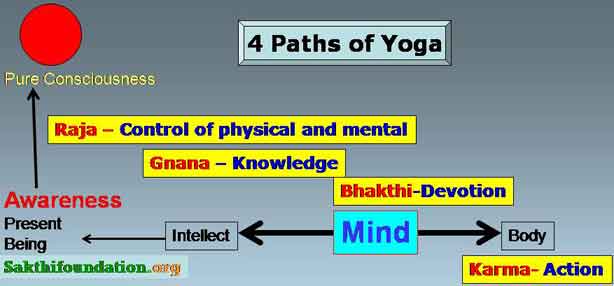
As we have seen earlier that the core principle of Vedic knowledge is to transcend to the Awareness state and identify that is the real nature of our being. This realization or Union in Sanskrit is known as "Yog". This is the root word for Yoga, which means to be in the Awareness state. As we have discussed earlier that Ego prevents the Transcendence to this Awareness state. There are four main means to transcend the ego. They are - Karma Yoga, Bhakti Yoga, Jnana Yoga and Raja Yoga. Each is suited to a different temperament of the individual or approach to life. All the paths lead ultimately to the same destination - to union with Brahman or Consciousness.
Karma Yoga, The Yoga of Action
Everyone are engaged in action always. But the Ego which is a single "I" thought takes the credit for all actions. Being aware of this Ego thought, one attributes the results of all actions to the awareness. This is the easiest means to sublimate the Ego and transcend to the Awareness state. This is the path chosen primarily by those of an outgoing nature. It purifies the heart by teaching one to act selflessly, which means not for the Ego. To achieve this, it is helpful to keep the mind focused by repeating a mantra while engaged in any activity.
. . 
Bhakti Yoga, The Path of Devotion or Divine Love
The Karma Yoga is for mankind involved in action. When an individual has matured in that Karma Yoga, he slowly gets into the next state of maturing his mind, called Bhakthi Yoga. This path appeals particularly to those of an emotional nature. The Bhakti Yogi is motivated chiefly by the power of of Love and sees God (Awareness) as the embodiment of love. Love is the nature of Awareness means to be united in Awareness.
Through prayer, worship and rituals an individual surrenders the emotions into unconditional love or devotion. Chanting or singing the praises of God form (Awareness) a substantial part of Bhakti Yoga. In one examines the praises of God, it is basically honoring the qualities of Awareness.
Jnana Yoga, The Yoga of Knowledge or Wisdom
This is the most difficult path, requiring tremendous strength of will and intellect. This occurs only when the individual has matured his or her mind and strengthens the intellect. Taking the philosophy of Vedanta, the Jnana Yogi uses his mind to inquire into its own nature. We perceive the space inside and outside a glass as different, just as we see ourselves as separate from (Awareness) God. Jnana Yoga leads the devotee to experience his unity with God directly by breaking the glass, dissolving the veils of ignorance. Before practicing Jnana Yoga, the aspirant needs to have integrated the lessons of the other yogic paths - for without selflessness and love of God, strength of body and mind, the search for self-realization can become mere idle speculation.
Raja Yoga, The Science of Physical and Mental Control
Often called the "royal road" it is the integration of the faculties of body, mind, intellect and Awareness. This method offers a comprehensive method for turning our mental and physical energy into spiritual energy (Awareness). Raja Yoga is also called Ashtanga Yoga referring to the eight limbs leading to absolute mental control. The chief practice of Raja Yoga is meditation. It also includes all other methods which helps one to control body, energy, senses and mind to transcend to the awareness state.
Subcategories
Festivals
Pilgrimages
Yathra
Yatra