uni5 Community
- Details
- Parent Category: uni5 Community
- Category: Matrix
- Hits: 16467
Spring summer fall winter ...and spring - A review
Spring, Summer, Fall, Winter... and Spring is beautiful elegant poetic movie with full of symbolism of man's spiritual journey. Change of seasons is inevitable like change in perceptions in life as we grow from childhood to old-age. It is an universal story about the human spirit, moving from Innocence, through Love and possession, suffering, redemption to Enlightenment and finally Rebirth.
Appluase to Director: Ki-duk Kim for this wonderful korean movie drawn like a painting.
The story is split into the four seasons as it begins and ends with spring as the title suggests. The beginning takes place in the spring as an old monk cares for a young boy who discovers the consequence of guilt the hard way as he torments a fish, a frog, and a snake. Like everyone doing harm to other human being or other beings in the environment is an injury to one's own self. This inter-connectedness is beautifully symbolized by the very change of seasons.
SPRING
The hermitage's sole occupants are an Old Monk (OH Young-soo) and his boy protégé Child Monk (KIM Jong-ho). While exploring the world , the Child Monk indulges in the capricious cruelties of boyhood. After tying stones to a fish, a frog, and a snake, Child Monk awakens to find himself fettered by a large stone Old Monk has bound to him. The old man calmly instructs the boy to release the animals, promising him that if any of the creatures die "you'll carry the stone in your heart for the rest of your life.”
The symbolism of the fish, frog and snake represent show how through our curiosity and greed led to disturb the eco-system where all beings lives in perfect harmony, where one becomes food for the other in the food chain. With man's child like innocence he does not know much much he is damaging nature, unless like the monk-teacher of the movie, spiritual masters make us realize that every creature that we kill by hampering the environment , we will carry the stone of injury for the rest of mankind's existence.
SUMMER
The doors open again on Boy Monk now aged 17 (SEO Jae-kyung) who meets a woman (KIM Jung-young) making a pilgrimage with her spiritually ill daughter (HAYeo-jin). "When she finds peace in her soul," Old Monk reassures the mother, "her body will return to health." The girl awakens desire in Boy Monk and the sensual flirtation between the two of them culminates in passionate lovemaking on pond-side rocks. The lovers are discovered by the Old Monk. The girl, now healed, is sent back to her mother. Forsaking his monastery home, the infatuated Boy Monk follows her.
The boundaries of the mind is really like the door that leads to the tiny Buddhist monastery and also the doors on the "no-walls" inside the hut. We can always be aware of our thoughts and go through a door or walk into our lusty desires without any rules. This is beautifully symbolized when the teenager triggered by the gush of the hormones stealthily beds with the girl. To avoid "warning" creaky door (inner voice) he does not hesitate to walk through the "no-walls" of self control. Not only do we filter our thoughts of desires but also our thoughts of outer actions, which is symbolized by the outer gate in the entry of the lake.
Like the rooster bird that is always engaged in pecking food, our mind always feeds on thoughts non-stop. When the teenage lad leaves the monastery, he takes this rooster, while zipping up the Buddha idol. This removing of Buddha's sculpture from the prayer pedestal and putting in the bag represents the stage of life when we live without an inner enquiry.
The monk uses the same rooster (thoughts feeding mind) to bring awareness to the teenager lad who has broken the boundaries of self control. This is why the monk uses the rooster to pull the boat towards the shore and then opens the vent to allow water to seep in the boat. The "coldness" of the reality wakes the young man of his mistakes and asks for forgiveness to which the monks prophecy " Desire leads to lust to possess followed by anger and then to even commit murder". The monk sees no difference of innocent act of desire and possess and murder that the young boy performed on the fish, frog and snake and now to himself and the girl.
FALL
Long absent from the monastery, Young Adult Monk (KIM Young-Min), now a thirty year old fugitive, returns to the raft still consumed by a jealous rage that has compelled him to commit a violent crime. When Young Adult Monk attempts penitence as cruel as his misdeed, Old Monk punishes him physically.
Chanting or reciting or writing of spiritual scriptures bring inner peace by purifying the mind which is nothing but clearing its own turbulences. This is beautifully symbolized by the Old Monk instructing Young Adult Monk to carve Pranjaparpamita (Buddhist) sutras into the hermitage's deck in order to find peace in his heart. Two policemen arrive at the abbey to arrest Young Adult Monk but let Young Adult Monk continue carving the sutras. Spiritual practices not only brings peace in one-self but also peace around people around you which is nicely shown as the warmth shown the two policemen on the Young Adult Monk. In-fact the two policemen finish decorating the sutras before taking Young Adult Monk into custody. Alone again, Old Monk prepares a ritual funereal pyre for himself.
Fire is the symbolism of purification of mind through knowledge. Saffron dress of Hindu, Buddhist and other traditions represents knowledge or the inner light. This is shown at many places but to quote two important places where light of inner knowledge is shown as a candle used for carving the sutras on the wooden floor. The other is the funeral fire of moksha or nirvana or liberation of the old monk. The old monk re-incarnates as a snake to preserve the tradition waiting for the return of the new monk.
The white cat the symbol of purification and awareness is the animal of the fall season...the season of speculation, inner awareness like the observing cat. This inner awareness helps us to overcome the weakness and transcend to the Self.
WINTER
The doors open on the now frozen pond and abandoned monastery. The now mature Adult Monk (played by director KIM Ki-duk) returns to train himself for the penultimate season in his spiritual journey-cycle. A veiled woman arrives bearing an infant that she leaves in Adult Monk's care. It is a great allegory here. The curious mind of the new monk is to unveil the face of the women who is nothing but the spirit of mother nature who disguises herself as the innumerable beings. We see that the monk placing Buddha's idol on the veil of the women.
In a pilgrimage of contrition, Adult Monk drags a millstone to the summit of a mountain overlooking the pond. He places Buddha's statue on the top acknowledging that he has discovered the Buddha in him who is at the top of the mountain witnessing the unending cycle of seasons and the accompanying ebb and flow of life's joys and sorrows. His discovery of Buddha is shown by unzipping the bag and taken out the Buddha and also carving Buddha out of the winter ice.
... AND SPRING
The doors open once again on a beautiful spring day. Grown from a child to a man and from a novice to a master, Adult Monk has been reborn as teacher for his new protégé. Together, Adult Monk and his young pupil are to start the cycle anew….
The baby boy is his own rebirth but now the boy does not make the mistake of the previous monk-boy who tied the fish, frog and snake. His mind has evolved to a turtle like stage which has a hard shell to with draw its organs to protect while sensing danger.
Both the monks try to transcend into their inner self by "shutting" their sensual organs like the eyes, nose, ears and mouth with pieces of paper inscribed with letter "shut". Later self-forced effort comes naturally and with ease like turtle withdrawing its organs. The new monk uses the "shutting" forcing himself for inner maturity, while the old one does for the final liberation.
Turtle is a powerful symbolic image in eastern spiritualism to denote a matured mind with with draws to itself when provoked by the dangers of external temptations. This is freedom or liberation, when the mind is liberated from the traps of external temptations. When the mind when knows to with draw, is free from suffering. This self mastering is the destination of spiritual journey, shown in the end of the movie Buddha statue looking at the rising sun in the spring of new-life.
- Details
- Parent Category: uni5 Community
- Category: Matrix
- Hits: 6720
Hero - A review
The Chinese movie Hero, with its excellent cast, brilliant storyline and visuals so remarkable they will leave you gasping with unique surprises and delights. Probably this is one of the rarest movie which shows the other good side of a tyrannical monarchy.
Hero is reportedly the most expensive Chinese movie ever made. Set 2,000 years ago and based on historic events, the film takes place at a time when China was divided into seven kingdoms. The ruthless king of Qin (Chen Daoming) wants to unite them under his rule, much to the dismay of rebels from other provinces who send assassins to the palace to show their displeasure. Such threats leave the king understandably nervous and in need of extreme security measures.
The film opens, when the King has learned that his three most deadly enemies have been vanquished by the humble sheriff Nameless (Jet Li). Nonetheless, Nameless' bravery earns him piles of gold and a private audience at the palace, during which he describes how he tricked and thwarted the best three warriors in the land. He portrays the story of his adventure of killing the assassinates to protect the king. The movie takes a beautiful turn when the king does not buy the story of Nameless and reveals the fact that nameless is in fact who with his story can approach the king and assassinate him.
The action travels back and forth in time as Nameless weaves his extraordinary tale, and we meet the dangerous Sky (Donnie Yen) and the lovers Broken Arrow and Snow (Tony Leung and Maggie Cheung). We also meet Broken Arrow's servant Moon (Zhang Ziyi), who can also wield her sword in a most lethal manner. This narration is shown in red colors. Next the King tells him that there is no truth in the story and he gives his version of the story in green. There is other versions of white and blue.
Finally the question is who is the Hero of the movie? Many attribute to the name-less, some to Sky or to broken arrow.
Peace, the Hero
But isn't "Peace" the real Hero?. Because it is for peace the king does unification of the kingdom and curbs terrorists or assassins. The beauty of the movie is that including the audience, the characters like Nameless, broken arrow and snow, as the movie progresses, learns the Truth that the King was really doing all this for peace of china. For this peace each one of them sacrifices their life. Broken arrow was the first to realize this truth about peace and so gives up chance of assassinating the king. By the end his wife Snow also realizes but by that time she had to give her life up also.
Nameless who came to assassinate the king finally understand the Truth that the King though his tyrannical rule was actually maintaining peace in the China. So he the leaves the King untouched. The King gains respect of Nameless but tragically had to kill the Nameless. Why?. The very same reason to maintain peace. If nameless was left un-killed, it would allow mushrooming of other terrorist to an assassinate the king.
The message of the movie in life is that we are all seeking Peace. There is a dialogue which says that the art of calligraphy and swordsmanship is the same because both seeks for peace. A calligrapher holds a brush for inner peace and so is a swordsman raising sword for peace. This is the beautiful message and symbolism of the movie Hero.
The art of "action" is stunningly portrayed by the the cool observing act of Snow as opposed to emotionally charged Moon. One stroke of sword through awareness is powerful than the charging wasteful actions of the restless emotional mind. This is another powerful expression of the movie while giving the great message of peace. So the external war is the same of the internal war towards peace. Hats off to the director Zhang Yimou.
- Details
- Parent Category: uni5 Community
- Category: Matrix
- Hits: 7534
What the bleep do we know? - A review
This is one of the best movie of the year 2004. Amanda, played by Marlee Matlin, finds herself in a sort of Alice in Wonderland and Neo in the Matrix world. Her daily, uninspired life is like of Neo’s “looking for an answer” type life. She literally begins to unravel, revealing the uncertain world of the quantum field , like Neo who took the red pill. This is a clean cinema with the philosophical concept of whether or not we actually exist – versus whether we are simply electrical impulses in this vast cosmic soup.
Amanda is sinks into a swirl of chaotic life incidences, while the characters she encounters on this journey reveal the deeper, hidden knowledge, the reality of the world. Like Neo in Matrix, Amanda is thrown into catastrophe, questioning the fundamental aspects of her life – that the reality she has believed in about material objects, fellow humans, relationships emotions etc isn’t reality at all!
Amanda journey starts in a train station (symbolizes journey) learns to relax into the experience, she conquers her fears, gains wisdom, and wins the keys to the great secrets of life, all in the most entertaining way. She is then no longer the victim of circumstances, but she leads herself to be the creative force in her life. She discovers her true “Self”.
The scientists and mystics interviewed in documentary style is a unique blend of new moving making. In an artistic way , their ideas are woven together with the self discovery of Amanda. They address the Great Questions that both science and religion attempts to answer. Over and over we find that in essence, both science and religion describe the same phenomena.
The film becomes worth watching with the animation it provides to realize the radical knowledge that modern science has unearthed in recent years. We are taken to the core of brain functioning and how bio-molecules (hormones) are translated into emotions and vice versa. Humor provoking animation introduces us to the smallest form of consciousness in the body – the neural cells and other body cells. We would understand how we create neuronal pathways which we may or many not be aware of, unless we later discover that these pathways are our addiction patterns. Like Neo in Matrix, we will understand that we have re-wire neural connections in our brain to see the reality of our own self and the universe. We do not understand the quantum reality because we program our neuronal connections in a certain way. Spiritual training is to de-clutch ourselves from these addiction pathways and witness the consciousness in us. This is the message of this movie.
Like Neo, Amanda stands before the Mirror and gets the reflection of her own self. The images of water crystals influenced by thoughts percolates into her understanding and she gets the deep wisdom that how much our thoughts would influence our body which is almost 90% water.
The boy in the basket ball court inspires her thinking which gives us the message that simple things around us can teach greater truths. Her self discovery does not again end in train station but continues to explore the quantum reality of the universe within her. With her self discovery she does not see any change in the universe that her senses continue to offer, but her perception has changed. That change brought her inner peace which is reflected as beauty around her and in her life.
This is a must see movie with no sex and violence. Caution: Do not take the interview of scientists and mystics as documentary clips, but visualize them as teachers helping Amanda in inner journey.
- Details
- Parent Category: uni5 Community
- Category: Matrix
- Hits: 26081
Buy Matrix Book in a secured way
 Buy Now using the secure Paypal system.
Demand Draft payment only accepted in India. Please pay Rs.450 to
Sakthi Foundation
113 Weavers Colony
Ondipudur
Coimbatore-641016
Tamil Nadu, India
We prefer only payment in US dollars ($ 9.99) to make shipment faster.
Are you like Neo looking for an answer about the Matrix, the reality of this universe and the purpose of life?
Then this is the book for you to quench your thirst. This is a feast for Matrix fans. Enjoy the movies to the fullest by understanding the symbolism of the three movies (Matrix, Matrix decoded and Matrix Revolutions).
This Book is written in the same sequence of the three Matrix movies and almost every important scene is commented. This helps the reader to connect to the movie and at the same time enjoy the symbolism and hidden meanings in the movies.
Don’t miss reading this book and enjoy watching the Matrix movies again (click for the forum discussion about the movie and book).
Book Award 2004 at
Hollywood Spiritual Film Festival
Please click here for more articles on Matrix Books.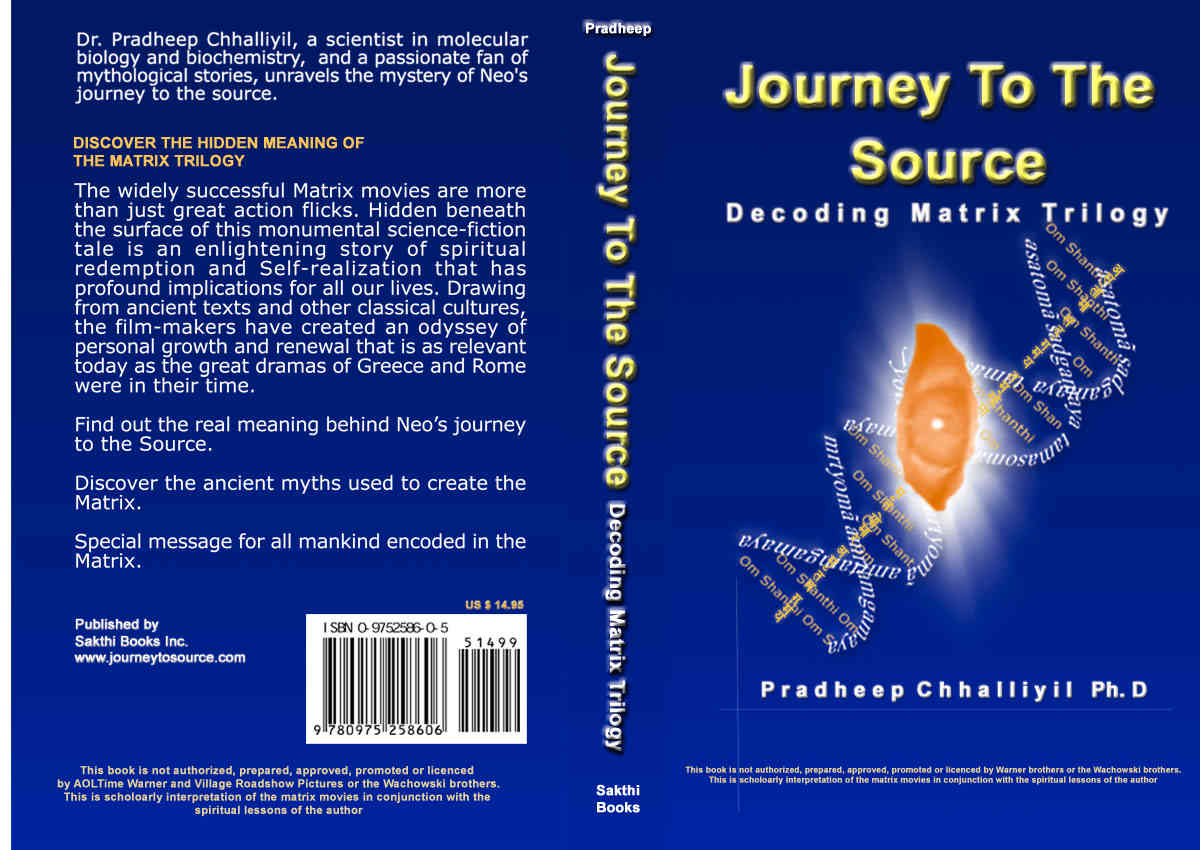
- Details
- Parent Category: uni5 Community
- Category: Matrix
- Hits: 10875
Spiritual movie reviews
Symbolism metaphor, interpretation, discussion, analogy and allegory .
Click on the left side links to read reviews of spirirtual movies. Please join the discussion in the forum also.
Inception
http://screenrant.com/inception-spoilers-discussion-kofi-68330/
http://www.cinemablend.com/new/An-Illustrated-Guide-5-Levels-Inception-19643.html
http://www.moviefone.com/2010/07/19/dissecting-inception-six-interpretations-and-five-plot-holes/
Subcategories
Uni5 Healthy Body
Uni5 Self Awareness
SAL Energy
Rituals and SAL Energy
Rituals in Sanathana Dharma
Festivals in Sanathana Dharma
Rituals in other Traditions
Festivals in other Traditions
CAC
CCC/CAC/Literature
Vedic Literature - English
We have organized this section in the Uni5 pattern
Body-Rituals and Festivals- About symbolism of rituals, festivals
Mind- Slokas-Music-About slokas, sthothras and music ragas
Intelligence-Gods-Scriptures-about the literature of gods.
Awareness-Temples / Pilgrimage- About temples, pilgrimages
Consciousness-Devotees-About the life history of all different devotees, including patriots
Vedic Literature - Tamil
We have organized this section in the Uni5 pattern
Body-Rituals and Festivals- About symbolism of rituals, festivals
Mind- Slokas-Music-About slokas, sthothras and music ragas
Intelligence-Gods-Scriptures-about the literature of gods.
Awareness-Temples / Pilgrimage- About temples, pilgrimages
Consciousness-Devotees-About the life history of all different devotees, including patriots
Vedas Sakthi
Festivals
Pilgrimages
Yathra
Yatra